I See Shapes
by Marcia Fries

Focus Story: I See Shapes by Marcia Fries.
Companion Story and Poem: Buttons, Buttons by Rozanne Lanczak Williams
Day 1
Prior Knowledge:
Show students a toy that they probably played with when they were very small - a shape sorter. Ask students to describe how they use to play with this toy. What did they have to do?
Focus Story:
Introduce the title, author and illustrator of I See Shapes. Ask students to describe the shapes that they see on the cover of the story.

Take a picture walk, letting students name the shapes that they see. Encourage the use of complete sentences, " I see ______." Talk about how the shapes are used to make other objects. Introduce the phrase from the story and have students repeat, "Now I see ______." Can they still see the original shapes? End the picture walk after students see the rectangles. Flip back through the pictures and talk about what the shapes turned into (hats, balloons, and presents) Letstudents make predictions about what the squares might turn into in relation to the other items. Read aloud for enjoyment and to see what object the squares turn into! After reading, ask students to brainstorm what object an oval might have become in the story.
Explain to students that over the next few days, they will be focusing on what makes each shape unique. They will look closely at one shape each day. (Please Note: This portion of the lesson each day could be done now or during math, depending on your schedule.)
Day 1 Shape: Circle
Read the circle poem. What other objects can students think of that are in the shape of a circle? Encourage students to find circles on their clothes and in the classroom. Teach students the 'Circle Shape Song' in which it is emphasized that 'a circle goes around and around without an end.' Let students practice making a circle by forming it in the air, on the floor, with their foot, etc. Show students many shapes and have them sort to find only the circles.
Day 2
Focus Story:
Reread the focus story, I See Shapes, encouraging students to join in on the repetitive phrases . Review with students what objects the shapes turned into. What was the special event? Ask students to think of another special event or place such as a circus, a classroom, their neighborhood, a park, etc. Explain to students that the class will make their own 'I See Shapes' book with each shape being used to form an object related to the chosen special event or place. Begin working on a predictable chart with students. Let each student choose a shape and think of what it could turn into. (The same shape will be used many times, but the item should be different.) "I see (shapes). Now I see (something made from that shape) Write each sentence on chart paper, writing their name at the end of the sentence. Reread each sentence tracking the print.
Companion Story
Pass around a small bag of various buttons, letting students reach into the bag, but not allowing them to look inside. Ask students to state what they believe is inside the bag. Do all buttons have to be round and in the shape of a circle? Introduce the author and illustrator ofthe book Buttons, Buttons. ask students to describe the buttons they see on the cover of the companion story. Take a picture walk, encouraging students to share how each button in the sets are similar. Read the story aloud for enjoyment. Were they surprised by the last type of button?
Day 2 Shape: Square
Read the square poem. What other objects can students think of that are in the shape of a square? Encourage students to find squares on their clothes and in the classroom. Teach students the 'Square Shape Song' in which it is emphasized that 'a square has 4 sides, all the same.' Let students practice making a square by forming itin the air, on the floor, with their foot, etc. Show students many shapes and have them sort to find only the squares.
Day 3
Focus Story:
Reread the focus story, I See Shapes, dividing the class in half and letting them alternate reading of the pages.
Ahead of time, prepare cards with various shapes. Show students one shape card picture at a time. Have them describe and name the shape. Repeat the name of the shape, clapping once for each syllable. Sort the shape card pictures by the number of syllables heard.
1 syllable : square, star, heart
2 syllables : oval, circle, diamond
3 syllables : rectangle, triangle, hexagon, trapezoid, pentagon
5 syllables :parallelogram
Reread the sentences that have been written on the predictable chart so far. Continue working on the predictable chart with students, letting students choose a shape and thinking of what it could turn into.
Companion Story:
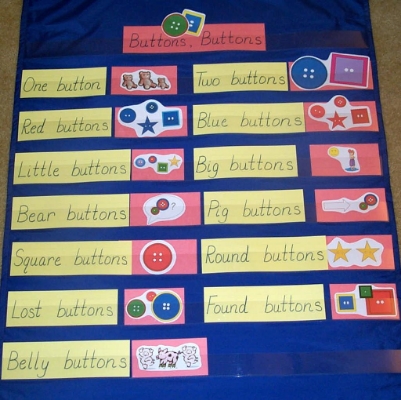
Reread the story Buttons, Buttons. with students. Next, show students a chart containing the words from the story and some simple, corresponding pictures. Read the chart aloud with students, using echo reading.

Printable Pictures for Buttons, Buttons Pocket Chart (in PDF)
Then let students search for certain letters within the 'Buttons, Buttons' Chart. Students can 'circle', 'square', 'rectangle', etc. the letters with fly swatters cut with different shapes!
Day 3 Shape: Rectangle
Read the rectangle poem. What other objects can students think of that are in the shape of a rectangle? Encourage students to find rectangles on their clothes and in the classroom. Teach students the 'Rectangle Shape Song' in which it is emphasized that 'a rectangle has 2 short sides and 2 long.' Let students practice making a rectangle by forming it in the air, on the floor, with their foot, etc. Show students many shapes and have them sort to find only the rectangles.
Day 4
Focus Story:
Reread the focus story, I See Shapes. Ask two volunteers to point to the words on alternating pages as the rest of the class reads the story aloud.
Work with students to use interactive writing to label each shape with its name and a short phrase description for each. For example, write the word "square' next to the picture of the square and write "4 sides all the same".
Reread the sentences that have been written on the predictable chart so far. As each word is read,. ask students to alternate between standing up and squatting back down. For example, "I' - up , "see" - down, "triangles" - up, etc. Complete the writing of the predictable chart today.
Companion Story:
Reread the story Buttons, Buttons. with students. Then, show students the 'Buttons, Buttons' Chart, in which the pictures are mixed up and no longer match the phrases. Remove all of the pictures and have students work to match the pictures to the corresponding phrases. Reread the fixed 'Buttons, Buttons' Chart together.
Day 4 Shape: Triangle
Read the triangle poem. What other objects can students think of that are in the shape of a triangle? Encourage students to find triangles on their clothes and in the classroom. Teach students the 'Triangle Shape Song' in which it is emphasized that 'a triangle has 3 corners and 3 sides.' Let students practice making a triangle by forming it in the air, on the floor, with their foot, etc. Show students many shapes and have them sort to find only the triangles.
Day 5
Focus Story:
Reread the focus story, I See Shapes. Ask two volunteers to point to the words on alternating pages as the rest of the class reads the story aloud.
Have each child reread his/her sentence from the predictable chart, tracking the print. Cut apart one sentence and let students "Be the Words' and organize themselves into the correct order. Read together. Model how to place each word in the correct order at the top of the page and then to draw a picture of their shape and what it turned into. Have students complete their class book page today.
Companion Story:
Reread the 'Buttons, Buttons' Chart together.
Day 5 Shape: Oval
Read the oval poem. What other objects can students think of that are in the shape of a oval? Encourage students to find ovals on their clothes andin the classroom. Teach students the 'Oval Shape Song' in which it is emphasized that 'an oval goes around, but is squished in.' Let students practice making an oval by forming it in the air, on the floor, with their foot, etc. Show students many shapes and have them sort to find only the ovals.
Possible Cross Curricular Connections
Math:
- Form shapes with string! Have partners listen carefully to directions and form specific shapes with their string. (This idea is adapted from Math in Motion by Betsy Franco, Creative Teaching Press: 2000.)
- Use buttons to copy, extend, and create patterns
- Sort buttons by size, color, shape, number of holes, animals, etc.
- Use Pattern Blocks to sort by color or shape, to name shapes, and to form patterns.
- Sort crackers by shape! (For example: Use Ritz for circles, Cheeze-Its for squares, Keebler Club for rectangles, Triscuits for triangles, and Townhouse for ovals!)
- Play 'Color and Shapes Bingo.'
- Let students practice making shapes in shaving cream, pudding, sand, etc. Then, have them trace and make shapes on paper. Printable Shapes Tracing Sheet (in PDF format)
- Play Shapes Race (from Box It Bag It)

Literacy:
- Focus on the sight words 'I', 'see', and "now".
- Match shape name cards to the corresponding picture of each shape.
- Make two sets of shape name cards. Have students match the words that are the same. Talk about the length of each word and count the number of letters in each.
- Have students work to make a shape and color 'Shape Monster' book in which they trace, color, and tear paper to make a predictable take home booklet. Students could work on one page each day to correspond with the above lessons or at a center with guidance. As students work on their booklets, ask them to orally describe what is special about each shape. (This idea originated from the sharing of a K teacher on the Teachers.net chatboard.)

Shape Monster Printable Booklet
(D'Nealian font)
Shape Monster Printable Booklet
(Avant Garde Font)
Music/Movement:
- Shape and Color Shapeman Says: Prepare necklaces for each child in the class that contain both a shape and a color. Give one to each child to wear. Students must listen to the teacher (Shapeman) to hear their color and shape be mentioned so that they know what movement to perform. For example, " Shapeman says 'All shapes with four sides and are red , hop four times.' or 'All blue circles do 3 jumping jacks.' (This idea is adapted from Math in Motion by Betsy Franco, Creative Teaching Press: 2000.)
- Play 'Musical Shapes' similar to Musical Chairs only place shapes on each chair and have students name the shape they sit down on!
Art:
- Use the Ellison Press to cut a variety of shapes in different colors. Have students arrange the shape pieces to form a 'Shape Picture' and glue it onto black paper.
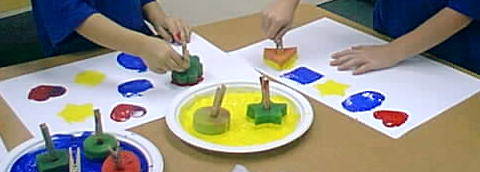
- Let students use sponge shapes to sponge paint the shapes and form a pattern.
3. Form Shape Sunflowers. Display these on a wall and allow students to take them home as they can point to and name all of the shapes used to form the sunflower. (This is a variation of the PKC teachers' Shape Jack in the Box.)

4. Incorporate lessons from TLC such as the caterpillar, traffic light, etc. to reinforce recognizing shapes, cutting shapes to form a picture, and following directions.
Science:
- Find items in nature and in the environment that are a certain shape. Have students orally state and describe the object in terms of its shape. For example: "The wheels on the car are round and look like a circle."
- Place items with a distinct shape into a bag. (For example, a milk cap, ball, penny, and yo-yo, etc. for circles, a block, a dice, a book, etc. for squares.) Have each child reach into the bag, touch one item, and describe the item by shape (number of sides and corners). Then have the student name other defining attributes that he/she notices and then state what the item might be called. Make a real graph with the items, labeling the columns with the names of the basic shapes.
Related Read Aloud Stories and Poems
Focus Story: I See Shapes by Marcia Fries.
Companion Story and Poem: Buttons, Buttons by Rozanne Lanczak Williams
Brown Rabbit's Shape Book by Alan Baker
The Button Box by Margarette Reid
Circles, Triangles and Squares by Tana Hoban
Circus Shapes by Stuart Murphy
Corduroy by Don Freeman
Grandma's Button Box by Linda Aber
The Greedy Triangle by Marilyn Burns
I Have Shapes by Rozanne Lanczak Williams
It Looked Like Spilt Milk by Charles Shaw
Mouse Shapes by Jim Arnosky
Round and Round and Round by Tana Hoban
Round and Square by Miriam Schlein
Sea Shapes by Suse MacDonald
The Secret Birthday Message by Eric Carle
The Shape of Me and Other Stuff by Dr. Seuss
The Shape of Things by Dayle Ann Dodds
Shape Space by Cathryn Falwell
Shape Spotters by Megan Bryant
Shapes by Jan Pienkowski
Shapes by John Reiss
Shapes and Things by Tana Hoban
Shapes, Shapes, Shapes by Tana Hoban
Shapes for Ten Tired Teddies by Prue Theobalds
The Shapes Game by Paul Rogers
So Many Circles, So Many Squares by Tana Hoban
Twizzlers: Shapes and Patterns by Jerry Pallotta
What Am I?: Looking Through Shapes at Apples and Grapes by N.N. Charles
What is Round? by Rebecca Dotlich
What is Square? by Rebecca Dotlich
What is a Triangle? by Rebecca Dotlich
When a Line Bends...A Shape Begins by James Kaczman
The Wing on a Flea: A Book About Shapes by Ed Emberley

Poems and pictures are from Color, Shape and Season Rhymes (Totline Take-Home Books) by Jean Warren, Warren Publishing House: 1989. ISBN: 0911019286
Shapes Song
(Tune: 'Here We Go 'Round the Mulberry Bush')
Author: Unknown
This is a (square) as you can see.
It has (4 sides all the same).
This is a (square) as you can see.
Now draw it in the air with me!
Other verses:
Rectangle: 2 short sides and 2 long
Circle: goes around without an end
Triangle: 3 corners and 3 sides
Oval: goes around, but is squished in
Related Resources
Shapes - shape activities from Little Giraffes
Shape Poems - from Can Teach
Shapes Math Tub - hands on ideas for learning shapes, inside Hubbard's Cupboard
Sort and Classify Math Tub - ideas for sorting, includes printable sorting mats, inside Hubbard's Cupboard