
The Three Little Pigs
by Paul Galdone

Focus Story:
The Three Little Pigs by Paul Galdone
Companion Story:
Pigs by Rozanne Lanczak Williams
Companion Poem:
To Market, To Market / To Market, To Market by Anne Miranda
Day 1
Old Favorites: Reread charts/poems from previous stories.
Prior Knowledge:
Present students with some real straw, a few sticks, and a real brick. Let students touch each material and discuss its texture, weight, sturdiness, etc. Ask students to think of a story that they have probably heard that includes all three types of materials. Encourage students to tell you what they already know about the story. Some students may say different things regarding what happens to the wolf at the end, etc. Explain to students thatThe Three Little Pigs has many different versions and each story is written a little differently.
Focus Story:
Introduce title, author and illustrator; Show the cover and talk about what the pigs are holding and where they appear to be; Read aloud for enjoyment and to see if this version of The Three Little Pigs is like the one the students remember.
Day 2
Focus Story:
Review the story, having students work together to sequence pictures from the story to show what happened first, second, third, next, etc.; Introduce the retelling chart (below)showing the repetitive words that the pigs and the wolf used in the story;
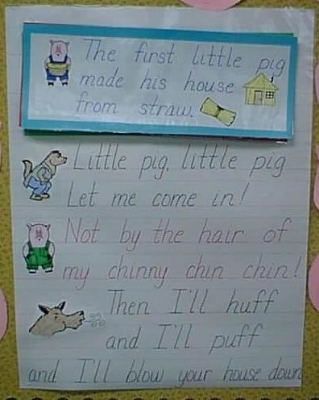

Reread the story- Shared Reading (letting students join in on the repetitive wording, pointing to the retelling chart); Generate a discussion regarding the characters, the problem, and the solution in this story by asking questions, such as the following...
- Why did the three pigs leave their mother?
- Why was the wolf able to blow down the first two pigs' homes?
- How do you think the first two little pigs felt when the wolf came knocking on their doors? How would you have felt?
- How do you think the third little pig felt when the wolf came to his house?
- Why couldn't the wolf blow down the third little pig's house?
- The wolf couldn't blow down the brick house, but the third little pig still had a problem. Who can tell us what that was?
- Why do you think the third pig was able to trick the wolf so many times?
- How would the story be different if the wolf was not a 'hungry' wolf?
- How would the story be different if all the little pigs had taken the time to build a brick house?
Companion Story:
Tell students that you have another story about pigs to share with them; Introduce title (Pigs) , author, and illustrator; Picture Walk discussing each picture so students understand that this book is about the daily antics of little piglets. This is a highly predictable book and the pictures closely match the text. Getting students to use the exact words when describing should be easy (number of pigs, preposition, object).; Read the story together.
Day 3
Focus Story: Reread-Shared Reading (letting students join in on the repetitive wording, pointing to the retelling chart.)
Companion Story:
Reread Pigs (echo reading); Reread the story, asking students to go on a rhyme hunt by listening for rhyming words; See if students can orally generate additional words that rhyme with each rhyming pair from the story.
Focus Story/Companion:
Discuss aspects of both The Three Little Pigs and Pigs that could be real and those that are fictional.
Pigs
Fictional:
pigs wearing hats and masks
pigs standing/balancing on top of each other
Real:
pigs being fed by a farmer
pigs sleeping in a pen
The Three Little Pigs
Fictional:
animals walking on two legs
pigs building houses
pigs and wolf talking in English
pigs cooking
pigs eating a wolf
Real:
little pigs having a mother pig
pigs being hunted by wolves
pigs being smart
Introduce some facts about pigs (body parts, piglets, characteristics, sounds, eating habits, where they live, how they are used to help people) by reading selected portions from a book such as Pigs by Gail Gibbons.
Day 4
Have students state/review some of the facts that they learned about real pigs.
Companion Rhyme:
Introduce the companion nursery rhyme 'To Market, To Market' (discussing the term 'market'); Read aloud; Reread (echo read).
Focus Story:
Encourage students to orally retell the story of The Three Little Pigs, stressing the concept of first, second, etc.; Have students act out the story. You will need three pigs, one mother pig, one wolf, three peddlers, and one person to point to the retelling chart sentences containing the repetitive words.
Companion Story:
Reread- Shared Reading (with half of the class reading the even pages/first half of the sentence and the other half of the class reading the odd pages/last half of the sentence and thus completing the rhyme); Choose students to find and mask certain letters ('p', 't', 'f', 'd', 's', 'g', and 'n') or to find small sight words (in, a, at, the, on).
Day 5
Companion Story: Reread Pigs (choral reading).
Companion Rhyme:
For enjoyment, read the book version of the companion rhyme To Market, To Market by Anne Miranda; Reread companion nursery rhyme 'To Market, To Market' (pausing for the rhyming words 'jig' and 'jog'); Explain to students that you have pictures that rhyme with either 'pig and jig' or 'hog and jog'. Have students sort the word family '-ig' and '-og' picture cards; Present students with the Take Home poem booklet – Read aloud together with students tracking the print. (This take home booklet is found in 25 Mother Goose Peek-A-Boo Books by Helen Moore, Scholastic: 1993.)
Focus Story: Have a second set of students act out the story (similar to yesterday).
Related Read Aloud Stories/Poems
Focus Story: The Three Little Pigs by Paul Galdone
Companion Story: Pigs by Rozanne Lanczak Williams
Companion Poem: To Market, To Market / To Market, To Market by Anne Miranda
Pigs by Gail Gibbons
Ten Pink Piglets byMary Rayner
The True Story of the Three Little Pigs by Jon Scieszka
The Fourth Little Pig by Teresa Clesi
The Three Little Wolves and the Big Bad Pig by Eugene Trivizas
Wait! No Paint! by Bruce Whatley
The Three Little Pigs by Sally Bell
The Three Little Pigs by James Marshall
All Pigs are Beautiful by Dick King Smith
The Great Pig Escape by Eileen Christelow
Pig, Pigger, Piggest by Rick Walton
Pigsty by Mark Teague
Jillian Jiggs by Phoebe Gilman
The Wonderful Pigs of Jillian Jiggs by Phoebe Gilman
If You Give a Pig a Pancake Laura Numeroff
Fiddle-I-Fee by Melissa Sweet
Barn Sneeze by Karen Winnick
It's a Perfect Day by Abigail Pizer
The Old Woman and Her Pig by Eric Kimmel
Alaska's Three Pigs by Arlene Laverde
Possible Cross Curricular Connections
Art:
1) Create the TLC To Market, To Market artwork (from More Nursery Rhymes)
2) Make pink paper pigs

3) Create playdough pigs
4) Experiment with straw paint blowing
Math:
1) Focus on ordinal positions (first, second, third, etc.)
Literacy:
1) Listen to the story at the listening center and use flannel characters to retell
2) Create a Venn diagram comparing two versions of this folktale
3) Make stick or stand up puppets for retelling at home
4) Make a Three Little Pigs Mural with interactive writing
Science:
1) Perform blowing/air experiments
2) Learn about real pigs (characteristics, where live, what eat, etc.)
Music/Movement: Sing/act out Ten Pink Piglets or manipulate the pigs on the poem chart (below)

Social Studies:
1) Learn about various types of homes/shelters
2) Make a collage of wants versus needs
The Three Little Pigs Resources
To Market, To Market- an interesting fifth grade unit study