The Enormous "Kinder" Garden
(Books about planting enormous things!)

The Enormous Watermelon by Brenda Parkes,
The Enormous Turnip by Kathy Parkinson,
The Enormous Potato by Aubrey Davis,
The Enormous Carrot by Vladimir Vagin
and Jack and the Beanstalk by Richard Walker
These lessons would be best if the activities could be spread out over several weeks.
Related Cross-Curricular Activities

The Enormous Watermelon
Introduce the Story
- Review and read the nursery rhyme 'Old Mother Hubbard'. Ask students to think back and remember the advice they gave to Mother Hubbard in helping her to solve her problem. (See The Gingerbread Man for a fuller introduction to this poem.)
- Show students the cover of the new story, but do not share the title. What does it look like Mother Hubbard decided to to?
- Show students a real watermelon and other fruits/vegetables that grow on vines such as pumpkins, grapes, cucumbers, cantaloupes, and beans. Show photos of how these fruits and vegetables grow. Ask students to explain/show how they might take the fruit/vegetable from the vine. Which might be the easiest/ most difficult fruit/vegetable to remove from the vine? Why?
- Introduce title, author and illustrator; What would it be like to remove an 'enormous' watermelon from the vine? Could you do it all by yourself?
- Take a picture walk: Let students use the picture cues in the story to predict which nursery rhyme character(s) will assist Mother Hubbard next. Then, have them use textual cues to figure out which word(s) say the name of the new character(s). Chant the corresponding nursery rhyme with the students. Make sure to stop the picture walk once Wee Willie Winkie has been introduced. Predict what the characters will do with the enormous watermelon.
- Read aloud for enjoyment.
Extensions
Literacy:
- Let students act out The Enormous Watermelon by pretending to be the nursery rhyme characters from the story. As each character is introduced in your class' play, have them sing the accompanying nursery rhyme!
- Make a predictable chart. What else could Mother Hubbard grow in the garden? " ______grows in the garden."
- Brainstorm other words for 'enormous.' What does enormous mean? (large, big, huge, gigantic, etc.)
- Chart a list of the characters from the story in order.
- Brainstorm other words that begin with the /w/ sound as in watermelon.
- Draw a large watermelon. Ask students to orally describe the watermelon. Then let the students help write the characteristics of the watermelon on the cut out. (large, juicy, black seeds, green rind, etc.)
- Read and sing Down By the Bay. Reread and pause for rhyming words. See how many other words students can say that rhyme with words from the song (bay, grow, goose, whale, fly, bear, llamas, time). Use the pictures (from Learning with Raffi: Singable Songs for the Very Young by Sherrill Flora, Instructional Fair: 1997) to create a small take home book for the students to share with their families!
- Have a rhyming seed sort! Use watermelon shaped notepads and black watermelon seed cut outs to have students match rhyming pictures. For example, on one watermelon place the picture of a cat. On several different seeds, place pictures of a hat, bat, mat, rat, etc. Students match the rhyming seed pictures to the corresponding watermelon! ( Printable Watermelon Rhymes Booklet - You'll still need to add rhyming pictures. I found mine in Fun Phonics Manipulatives by Hancock, Pate, and VanHaelst, Scholastic: 1997.)
- Sing/Chant 'Watermelon Pie' (original lyrics by Sharon McDonald).
- Bring in a real watermelon pie for students to taste!
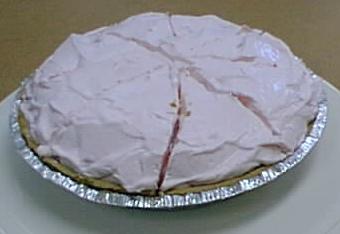
Then create a class book called 'Watermelon Pie' (very similar to Kim's 'Alligator Pie' book originally at KinderNet). Make the booklet in the shape of a watermelon piece and add the following words...
'Watermelon Pie'
Words: Watermelon Pie! Watermelon Pie!
Pictures: watermelon and a pie
Words: If I don't get some I think I'm going to cry!
Pictures: student crying with large tears shown
Words: You can take away my shirt.
Pictures: shirt
Words: and take away my tie.
Pictures: tie
Words: But please don't take my watermelon pie!
Pictures: watermelon and a pie
(Just as "Alligator Pie' can be changed, you could vary 'Watermelon Pie' to be cake, tea, stew, etc. Then let students come up with words that rhyme with the new type of watermelon. Substitute the original words of pie, cry, shirt, and tie with the new words and reread!)
Math:
- Read One Watermelon Seed. Predict how many seeds are inside of a watermelon. Open it up and count the seeds! Count each seed into groups of ten and then count by tens to one hundred!
- Label 11 bags with the numerals 0-10, Have students read the numeral, count out that number of watermelon seeds into each bag, and then place bags in order 0-10. Also make number word cards and have students match each word to the correct bag.
Science:
- Begin your class' Enormous "Kinder" Garden by planting watermelon seeds! This will be the start of a class literacy garden for all of the 'enormous' growing books that you read together. Let students make a corresponding label or sign for each story that you read and each seed that you plant!
- Keep track of the planting and growth you see in the garden by either keeping a whole class Garden Journal or by letting each child have their own Garden Journal.
Fine Motor:
- Create paper plate watermelons. Cut white paper plates in half. Cut out a few wavy lines at the top to make it look like a bite. Paint using red for the inside, green for the rind, and black for the seeds.
- Or make torn paper watermelons!
Ideas to use with Companion Stories

The Enormous Turnip
Introduce the Story
- Before reading, review with students what happened in The Enormous Watermelon.
- Show students the cover of the book and discuss what this new story might be about. What is growing in the garden this time? Let students figure out the title of the story by using what they know from the previous story, The picture on the cover, and the textual cues.
- Once students have figured out the title of the story, show them a real turnip and other edible roots that you can't see as they grow underground such as a carrot, radish, beet, and potato. Show and discuss how these vegetables grow.
- Introduce the author and illustrator; Review the title - What would it be like to remove an 'enormous' turnip from the ground? Do you think it would be easier or more difficult than the enormous watermelon?
- Take a picture walk to see who helps this time (the characters) and how they are able to get the enormous turnip from the ground. Make sure to stop the picture walk once the beetle has been introduced. Predict what the characters might do with the enormous turnip if they do remove it from the ground.
- Read aloud for enjoyment.
- After reading, discuss what the characters might have learned from this experience such as teamwork, everyone being able to make a difference, etc.
Extensions
- Have students brainstorm other things that are truly enormous (elephant, whale, mountain, etc.). Make a heading of 'What is Enormous?' Write what students say on sentence strips in the format of 'A ______ is enormous.' Then let students illustrate each item. Leave these sentences in the pocket chart for students to read and/or write during Read and Write the Room
- Brainstorm other words that begin with the /t/ sound as in turnip.
- Draw a large turnip. Ask students to orally describe the turnip. Then lett he students help write the characteristics of the turnip on the cut out. (reddish white outside, green leaves, hard, root, grows underground, etc.).
- Chart a list of the characters from the story in order. What do you notice about the size of each character as the story progresses?
- Plant turnip seeds in the class' Enormous "Kinder" Garden!
- Continue to keep a record of growth and other observations about the garden in the Garden Journal.

The Enormous Potato
Introduce the Story
- Before reading, review with students what happened in The Enormous Watermelon and The Enormous Turnip. How were the two stories alike? How were they different?
- Tell students that you have a new 'enormous' growing story to share with them and they have to figure out what type of plant it is before reading the story. Show students a box that contains a hidden potato inside and the story The Enormous Potato. Have students listen to clues to figure out what type of 'enormous' plant might be growing in the new story. You may wish to use the following clues...
Like The Enormous Turnip, this plant is a root that we can eat.
It has eyes all over it.
It is white on the inside.
It has a brown skin.
It grows with a green leafy stem.
It is usually in the shape of an oval.
You can do many things to this plant to make it taste different (fry, bake, mash, etc.).
- Once students have guessed the 'enormous' growing plant in the story, show them the potato and the book. Introduce the title, author, and illustrator. Read aloud!
Extensions
- Act out the story!
- Draw a large potato shape and have students list all of the characteristics of a potato.
- Brainstorm other words that begin with the /p/ sound as in potato.
- Chart a list of the characters from the story in order. What do you notice about the size of each character as the story progresses? Compare with the other 'enormous' stories.
- Create a Venn Diagram with the students comparing the two stories of The Enormous Turnipand The Enormous Potato.
- Learn about Potato Eyes! Bring in real potatoes for students to look at closely with magnifying glasses. Can they see the eyes of the potato. How many eyes does it have? Conduct a potato experiment or find out what the eyes of a potato are for. Start by inserting toothpicks into the sides of a potato and then placing the potato halfway into a jar of water. Students should be able to see new sprouts begin to grow in a few days!
- Cut apart the potato and plant each of the eyes in the class' Enormous "Kinder" Garden.
- Don't forget to keep drawing and writing about what is happening in the ever growing "Kinder" Garden!

The Enormous Carrot
Introduce the Story
- Before reading, review with students what happened in the other 'enormous' growing stories.
- Show a real carrot (including the green stem). Invite students to tell you which part of the carrot we eat. On the chart of the carrot, write the students' descriptions of a real carrot(orange, long, skinny, root, green leaves, grows underground, bunnies like to eat, good for eyesight, etc.)
- Introduce the title, author, and illustrator of the new story. Take a picture walk! Let students predict who will help next. Look closely at each new animal character and describe what each is doing to help. What does each character bring to assist? End the picture walk after the mouse is introduced. Read aloud the story to see if the characters are able to pull up the carrot and what they do with it in the end.
- After reading discuss how each animal generously shared the resources that they had. Point out that theyeven shared the enormous carrot with animals that did not help to remove the carrot from the ground!
Extensions:
- Brainstorm other words that begin with the /c/ sound as in carrot.
- Chart a list of the characters from the story in order. Compare to the list of characters in the other 'enormous' growing stories.
- Create carrot and bunny matching games for your students. Here are some ideas to get you started...
numerals and sets
upper case letters to lower case letters
pictures to the corresponding beginning or ending letter
pictures to pictures that begin with the same letter
rhyming pictures
- Set a carrot top in water and watch it grow. You'll have a lovely carrot top plant!
- Plant carrot seeds in the class' Enormous "Kinder" Garden!
- Continue to make additional observations in your Garden Journal!

Jack and the Beanstalk
Introduce the Story
- Orally tell students the name of the story that will be read. Encourage students to tell you what they already know about the story. Some students may say different things regarding what happens to the Jack and the Giant at the end. Explain to students that Jack and the Beanstalkhas many different versions and each story is written a little differently.
- Introduce the cover, title, author, and illustrator. Before reading, explain that although the word 'enormous' is not part of the title of this story, there will be some enormous things to be on the lookout for!
- After reading, discuss the items in the story that could have been called 'enormous.'(beanstalk, giant, objects in the giants house, etc.)
Extensions
- Brainstorm words that begin with the /b/ sound as at the beginning of the word beanstalk.
- Read How a Seed Grows or One Bean. Then plant lima beans near the class' Enormous "Kinder" Garden! Loosely wrap three to four lima beans in a wet paper towel. Place inside the plastic sandwich bag, but do not seal. Attach the bags to the window. Watch for sprouts to form within a few days!
- You might try an experiment with your beans! Place some of the bags in a dark spot. Ask students to predict , whichseeds will grow the best. Why? Review with students that all living things need in order to grow -water, air, food.
- Keep track of your fast bean growth in a separate Bean Journal or add it to your Garden Journal.
Related Cross Curricular Activities
Math:
1) Seed Sort- Group seeds by color, size, texture, shape; order objects and/or characters from largest to smallest.
Science:
1) Read Tops and Bottoms and discuss the parts of plants that we eat. Then graph vegetables by whether we eat the tops, bottoms, or middles
2) Conduct experiments with the 'enormous' growing plants - watermelon, turnip, potato, carrot, and bean. Make predictions and then test to find out the following about each type of plant...
Does it roll? Why or why not?
Can it float? Or does it sink?
What is it's weight? Which is the lightest, heaviest? Are any the same weight?
How big around is it? (circumference)
How long is it? (length)

Literacy:
1) Sort pictures of vegetables and fruits by their number of syllables
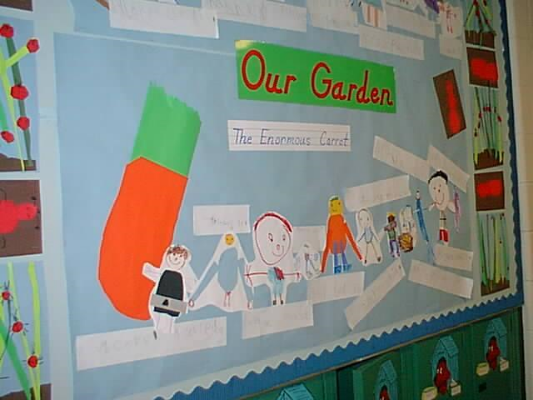
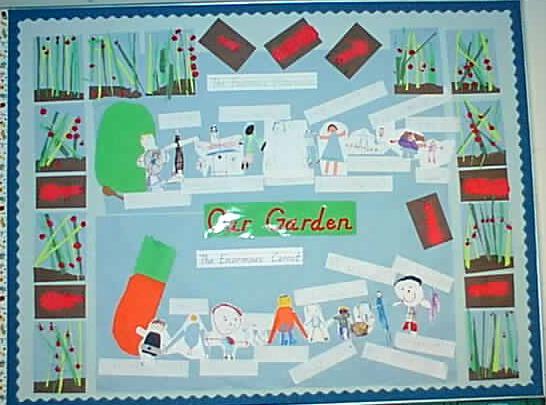
2) Make a class mural with each student making a picture of themselves and then writing '(Name) pulled it.' (From Interactive Writing by McCarier, Pinnell, and Fountas, page 127.)
3) Act out/sequence/order events from the stories
4) Make stick puppets to accompany one of the stories
5) Sort pictures by whether they begin with Ww, Tt, Pp, Cc, or Bb
6) Read and learn more nursery rhymes
Art:
1) Make fruit and vegetable prints
Social Studies:
1) Focus on the character traits of cooperation and helpfulness
Related Garden Read Aloud Stories and Poems
Focus Story: The Enormous Watermelon by Brenda Parkes
Companion Stories:
The Enormous Potato by Aubrey Davis
The Enormous Turnip by Kathy Parkinson
The Enormous Carrot by Vladimir Vagin
The Carrot Seed by Ruth Krauss
Jack and the Beanstalk by Richard Walker
Companion Poems: Poems in Anna's Garden Songs by Mary Steele
Watermelon
'Watermelon Pie' song by Sharon MacDonald
Down By the Bay by Raffi and Nadine Bernard Westcott
One Watermelon Seed by Celia Barker Lottridge
Fruits and Vegetables
The Carrot Seed by Ruth Krauss
The Gigantic Turnip by Aleksei Tolstoy
Giants Have Feelings, Too/Jack and the Beanstalk (Another Point of View) by Alvin Grawowsky
Eating the Alphabet by Lois Ehlert
Growing Vegetable Soup by Lois Ehlert
The Surprise Garden by Zoe Hall
A Garden Alphabet by Isabel Wilner
Oliver's Vegetables by Vivian French
Mrs. Rose's Garden by Elaine Greenstein
Mrs. McNosh and the Great Big Squash by Sarah Weeks
We Can Eat the Plants by Rozanne Lanczak Williams
Muncha! Muncha! Muncha! by Candace Fleming
Tops and Bottoms by Janet Stevens
Seeds/Living Things in General
What's Alive? by Kathleen Weidner Zoehfeld
A Seed is a Promise by Claire Merrill
I'm a Seed by Jean Marzollo
One Bean by Anne Rockwell
How a Seed Grows by Helene J. Jordan
Flowers, Fruits, and Seeds by Jerome Wexler
From Seed to Plant by Gail Gibbons