Rain
by Robert Kalan

Focus Story:
Rain by Robert Kalan
Companion Story:
Rain by Rozanne Lanczak Williams
Companion Poems:
'Rain' and 'Plant a Little Seed'
Day 1
Old Favorites: Reread charts/poems from previous stories.
Prior Knowledge:
How do you know when it is about to rain? Do you like rainy weather? What types of things do you do when it rains?
Focus Story:
Introduce the title, author, and illustrator of this week's focus story Rain. Show the cover and discuss how the word 'Rain' is written over and over to resemble rain coming down onto the earth and hills. Take a picture walk. The inside text closely matches the pictures and some lines of text are colored to correspond to the color word and colors seen on that page. Encourage students to name what they see and what color it is (exp. 'Blue sky'). Stress that the text and the picture cues both help us to read the story. See if students can point out some of the color words in the story. End the picture walk after the rain falls on the green trees. Ask students to make predictions- Will the rain ever stop? What might happen as the rain stops? What are some signs that the rain might end soon? Read aloud for enjoyment.
Companion Poem:
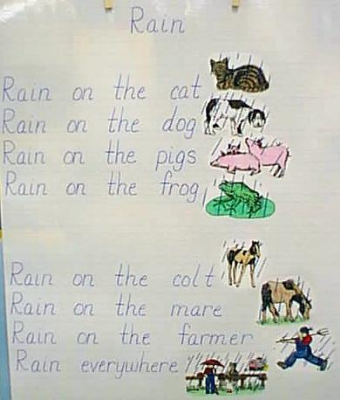
Introduce the companion poem 'Rain'. (Choose either the short version or the longer version. See photos below.) See if students can mask the word 'Rain' from our focus story and the repeated sight words 'on' and 'the'. Let students use the pictures to read the last word in each sentence. Read the poem aloud so students can check their decoding and enjoy the poem. Echo read.

Day 2
Focus Story:
Reread Rain by Robert Kalan. Show students pictures that are similar to the book (blue sky with white clouds and a yellow sun, gray clouds with the sun partially hidden, gray clouds with no sun, rain, rain with sun peeking behind clouds, rainbow). Let students discuss what they see in each picture and place the pictures in order so that they show the sequence of the story. Shared Reading - reread and let students be your echo after each page/line.
Companion Poem: Reread the companion poem 'Rain' (choral reading).
Companion Story:
Show students the cover of the companion story Rain by Rozanne Lanczak WIlliams. Introduce the author and illustrator, but see if students can read the title of the story. Take a picture walk having students explain what the rain is on in each picture. Ask students 'What is it raining on? How is the little girl protected from the rain? What is she wearing/using? Are any of the insects and animals protected? How?'. Read the story together. After reading, ask students the following questions - What is rain good for? Why do we need rain? What might happen if it did not rain? What might happen to the plants and animals?
You may wish to read a story about what all living things need. A great book for this age level is What's Alive? by Kathleen Weidner Zoehfeld. After reading, sort pictures of living and non living things. Stress that all living things grow and that they need air, water, and food.
Day 3
Companion Poem: Reread the companion poem 'Rain' (choral reading).
Companion Story:
Reread the companion story Rain by Rozanne Lanczak WIlliams. Review how rain is helpful to all living things.
Focus Story:
Pass out either a colored sheet or a color word to each student. Have students find their partners by matching the colors and color words. To reread the focus story, each pair of students will be asked to read their corresponding color page.
Extra Science Connection:
Talk about which of the colors in the story actually make up a rainbow. You may wish to read a book about rainbows such as All the Colors of the Rainbow (Rookie Read-About Science) by Allan Fowler. Brainstorm ways that the class could make their own rainbow (paint, color, etc.). Then ask if they think it is possible to plant a rainbow. Read aloud Planting a Rainbow by Lois Ehlert. Plant a 'rainbow' with students by bringing in annuals that are the colors in the rainbow (red, orange, yellow, green, blue, indigo, violet). Before planting, show, discuss, and label the parts of a flower. Then plant the flowers in the order of the colors of the rainbow to make a Rainbow Garden!
Day 4
Companion Poem and Story:
Reread the companion story Rain. Reread the poem 'Rain'. (Choral read, letting half of the class read the first line and the other half of the class read the second line, alternatively.) Mask letters and sight words within the poem and story.
Focus Story:
Read together the story Rain by Robert Kalan. Review with students how they recently planted a rainbow.
Companion Poem:
Introduce the second companion poem 'Plant a Little Seed'. Pantomime actions to the poem as you read it together...
I plant a little seed in the dark, dark ground.
(Bend down, dig hole, push seed into ground and cover with dirt.)
Out comes the yellow sun big and round.
(Hold arms up over head in a circle)
Down comes the rain, soft and slow
(Hold arms out over head, with fingers moving. Move arms slowly down to the floor.)
Up comes the little seed.
(Squat down. Touch fingers to floor and come up slightly.)
grow, grow, GROW!
(Move body up as though you are the flower, until you are standing with arms up.)
Review what plants and all living things need in order to grow. Begin work on a class mural showing what plants need to grow (sun, rain, soil) and the Rainbow Garden of flowers that they planted yesterday.
Make some time to read the story Grow Flower Grow! (also called Fran's Flower) by Lisa Bruce. It is a cute story about a little girl who feeds actual food to her flower and can't figure out why it is not growing!
Day 5
Companion Poem and Story: Reread the companion story Rain and the companion poem 'Rain'.
Focus Story:
Read together the story Rain by Robert Kalan. Complete work on the class mural - Use interactive writing to label the sun, soil, rain, color of each flower, etc.

Companion Poem:
Reread and act out the second companion poem 'Plant a Little Seed'. Make a torn construction paper booklet to illustrate the poem. Students can take it home to remember what plants need in order to grow and to read again and again!
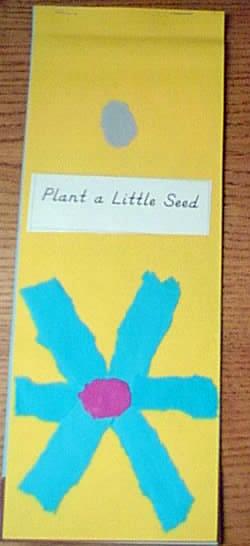
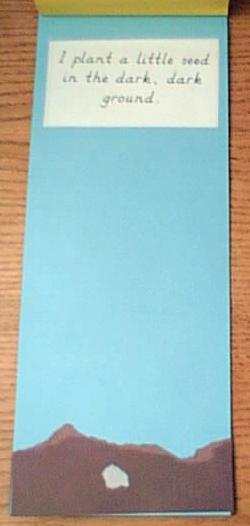
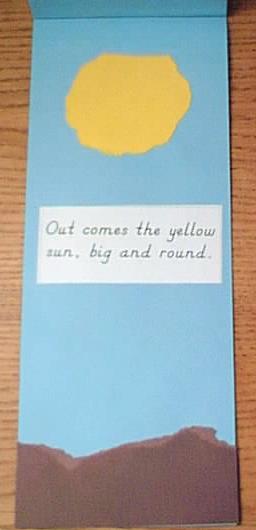
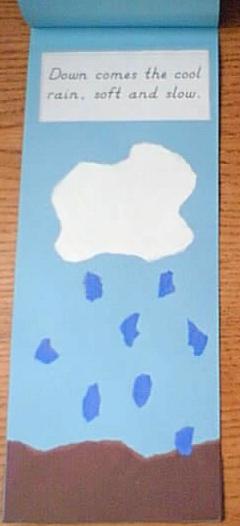
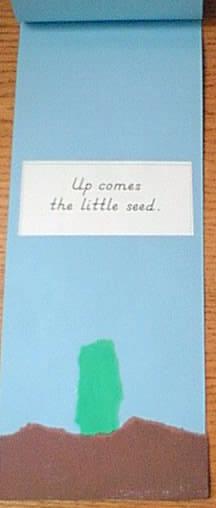
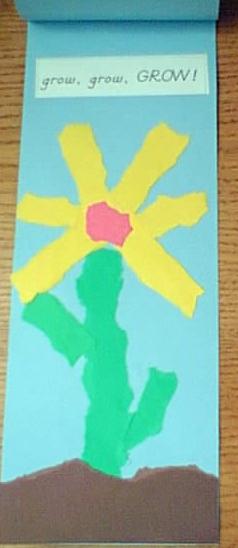
(Thanks to Kim Martin for sharing this great booklet idea!)
Printable Words to 'Plant a Little Seed'
Related Garden Read Aloud Stories and Poems
Focus Story: Rain by Robert Kalan
Companion Story: Rain by Rozanne Lanczak Williams
Companion Poems: 'Rain' and 'Plant a Little Seed'
Rain
Down Comes the Rain by Franklyn Branley
Rain Song by Lezlie Evans
Rain by Peter Spier
In the Rain With Baby Duck by Amy Hest
All the Colors of the Rainbow (Rookie Read-About Science) by Allan Fowler
The Rain Came Down by David Shannon
Puddles by Jonathon London
Red Rubber Boot Day by Mary Lynn Ray
This Is the Rain by Lola M. Schaefer
Flowers
Planting a Rainbow by Lois Ehlert
Sunflower House by Eve Bunting
Flower Garden by Eve Bunting
Fran's Flower or Grow Flower Grow by Lisa Bruce
Bumblebee, Bumblebee Do You Know Me? by Anne Rockwell
Jack's Garden by Henry Cole
The Reason for a Flower by Ruth Heller
Seeds/Living Things in General
What's Alive? by Kathleen Weidner Zoehfeld
A Seed is a Promise by Claire Merrill
I'm a Seed by Jean Marzollo
Flowers, Fruits, and Seeds by Jerome Wexler
From Seed to Plant by Gail Gibbons
The Tiny Seed by Eric Carle
A Little Seed
A little seed for me to sow.
A little earth to make it grow.
A little hole, a little pat
A little wish and that is that.
A little sun, a little shower,
A little while, and then a flower

Possible Cross Curricular Connections
Math:
1) Label flowerpot shapes with numerals and then have students count out that many flower shaped erasers into each pot.
2) Create flowers using pattern blocks and then glue paper pattern block pieces to recreate.
3) On a rainy day, collect rain in a rain gauge and measure how much water you get.
Science:
1) Plant a flower garden!
2) Label the parts of a plant (flower, stem, leaf, roots).
3) Conduct plant experiments such as celery experiment for demonstrating how the plant gets water; light, water, air experiments.
4) Make rainbow crayons.
Literacy:
1) Sequence/order events from story and plant growth.
2) Brainstorm additional rhyming words for 'me' and then insert them into the poem 'Rain' to reread.
3) Match pictures that end with the same sound. (See below.)

Art:
1) Make a seed collage.
2) Create hand print flowers. (See below.)

Related Rain and Flower Resources
Rain/Rainbows/Colors
Orange is a Carrot and Rainbow - a booklet by Kim to make with students
Raindrops with Glue - from SB Creatively
Flowers
Kim's Sunflower Book- a booklet to make with students

See a related study at Hubbard's Cupboard called The Enormous "Kinder" Garden! See ideas to use with growing fruits and vegetables such as The Enormous Watermelon and The Enormous Turnip!