Mouse Mess
by Linnea Riley

Focus Story: Mouse Mess by Linnea Riley
Companion Rhyme: 'Hickory Dickory Dock'
Day 1
Old Favorites: Reread charts/poems from previous stories
Prior Knowledge:
Bring in a box of crackers and a package of cheese to share with students. Show the packages to the students and let them tell you what they notice about each (type of food, product name, certain letters, etc.) Have students help set up plates, napkins, and cups and to serve the snack. Encourage students to nibble on their snack as they believe a mouse would.
Focus Story:
Ask students 'What is your favorite snack? How do you make it? Are you able to fix it without adult help? What do you do with your plate, napkin, or cup when you are finished eating your snack?'
Introduce the title and author of the new story. Have students look at the cover and discuss what type of snack the mouse might like. Take a picture walk through the story, stopping before last page, letting students point out and name the types of food shown.; Read Mouse Mess aloud for enjoyment and to see how story ends.
After reading , ask students to share what they think might happen the next morning as the people who live in the house come down and see the big mess.
Day 2
Focus Story:
Reread for enjoyment. Read again, letting students mask certain letters in the story. Introduce a song about another hungry mouse who needs the students help - 'Hungry Mouse.'
Hungry Mouse
(tune: I'm a Little Teapot)
I'm a little hungry mouse.
Can't you see?
Foods that start with
______ are for me!
Would you please pack me
a great big lunch?
What do you think
I'd like to munch?
(Adapted from Spring Phonemic Awareness Songs and Rhymes by Jordano and Callella Jones; Creative teaching Press, 1998.)
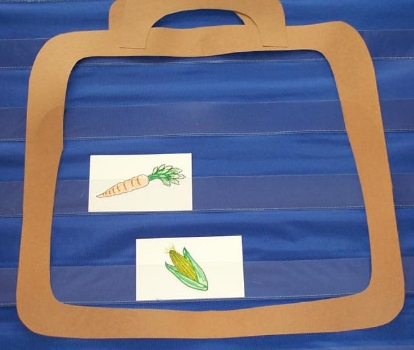
Place the lunch box cut out over a pocket chart. Let students choose food picture cards that begin with the same sound the mouse sang about into the pocket chart lunchbox. Repeat, using a different sound as your focus.
Predictable Chart:
Explain to students that during the week they will get to make their own mouse. Explain that their mouse will only like foods that start with a certain letter - just like the Hungry Mouse. Their mouse will like foods that start with the same letter that their name begins with. Let students help each other brainstorm possible foods each of their mice could like. For example, Peter's mouse could like peas, pizza, pancakes, etc. Then write one of them on chart paper. For example, " Peter's mouse likes pizza." Complete a few sentences each day either as a class or in smaller groups depending on how much adult help you have available. Reread each sentence tracking the print.
Companion Rhyme:
Introduce the companion nursery rhyme 'Hickory Dickory Dock' in which there is another mouse in a house. Read aloud for enjoyment. Let students brainstorm reasons why the mouse might have ran up and then down the clock.
Day 3
Companion Rhyme:
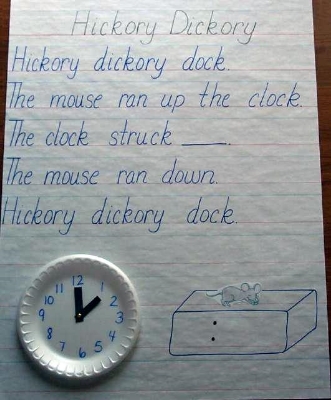
Reread the companion nursery rhyme 'Hickory Dickory Dock.' Introduce the interactive chart and let students change the hands on the clock and write in the numbers on the digital clock so that they match.
Focus Story:
Reread Mouse Mess, letting students quietly touch their mouth each time they hear a certain sound in the story.
Predictable Chart:
Complete the writing of the predictable chart in which students think of foods that begin with the same letter that their name starts with. ( _____'s mouse likes ____.) Reread each sentence tracking the print.
Day 4
Focus Story: Reread Mouse Mess, having students listen for the rhyming words.
Companion Rhyme:
Reread companion nursery rhyme 'Hickory Dickey Dock' (choral reading ½ class). Read the expanded version of the rhyme in The Completed Hickory Dickory Dock by Jim Aylesworth. Afterwards, see if students can share some of the rhyming words that they heard.
Predictable Chart:
Have each child reread his/her sentence, tracking the print. Model how to place each word in the correct order at the top of the page and then to draw a picture of the food mentioned in their sentence Let students attach their previously made mice to their paper.
Day 5
Companion Rhyme: Reread companion nursery rhyme 'Hickory Dickory Dock.'
Focus Story: Reread the story, pausing for students to fill in words.
Take Home:
Read aloud Mouse's Lunch (below). Have students brainstorm other items mouse could munch. Make a list for students to see using words and drawings. As a class decide on 5 items for the mouse to eat. Circle these and write numerals next to them. Model for students how to make their own Mouse's Lunch booklets making sure to look for the next number needed and drawing that many of that particular food. Reread as a class and then students take home the booklet to share with their families over and over!
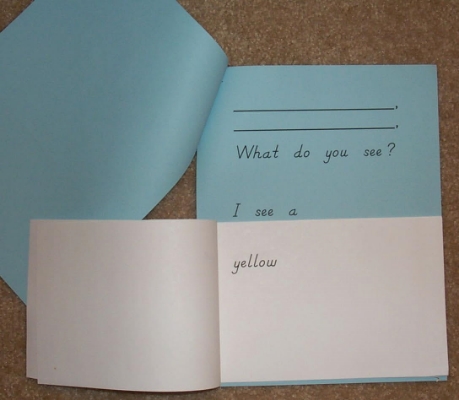
Print your own Mouse's Lunch booklets!
Cover and Back Page
Inside Sheets
Related Read Aloud Stories/Poems
Focus Story: Mouse Mess by Linnea Riley
Companion Rhyme: 'Hickory Dickory Dock'
Alexander and the Wind Up Mouse by Leo Lionni
Come Out and Play Little Mouse by Robert Kraus
Completed Hickory Dickory Dock, The by Jim Aylesworth
If You Give a Mouse A Cookie by Laura Numeroff
If You Take a Mouse to School by Laura Numeroff
Lion and the Mouse, The by Cheyenne Cisco
Little Mouse, The Red Ripe Strawberry, and The Big Hungry Bear, The by Don and Audrey Wood
Lunch by Denise Fleming
Mice Squeak, We Speak by Arnold Shapiro
Mouse Count by Ellen Stoll Walsh
Mouse in the House by Patricia Baehr
Mouse Paint by Ellen Stoll Walsh
Mouse Views: What the Class Pet Saw by Bruce McMillan
Outside Rats and Mice by Sandra Markle
Three Blind Mice by Paul Galdone
Town Mouse and Country Mouse by Jan Brett
Two Hungry Mice by Alan Baker
Whose Mouse are You? by Robert Kraus
Mice
(by Rose Fyleman)
I think mice
are rather nice.
Their tails are long.
Their faces small.
They haven't any
chins at all.
Their ears are pink.
Their teeth are white.
They run about
the house at night.
They nibble things
they shouldn't touch.
And no one seems
to like them much.
But I think mice
are nice.
Five Little Mice
(author Unknown)
Five little mice
hungry as can be
went to the kitchen
to see what they could see.
The first mouse found a cookie crumb.
Ate it and said...
"Yum! Yum! Yum!"
The second mouse found some bread.
"That looks good to me!" he said.
The third mouse said,
"What a break!
I just found
a piece of cake!"
The fourth mouse saw
a big slice of cheese.
"I'll eat this before anyone sees!"
The fifth mouse yelled,
"We'd better scat!
Here comes a great big cat!"
Possible Cross Curricular Connections
Art:
- Make mice from paper, making sure all parts of a mouse are included!
- Make mice using thumbprints! Students cut out environmental print (what they think their mouse would like to eat). Then add a few crumbs to the picture to make their own mouse mess!
- Hickory Dickory Dock craft. (See below.)

Math:
- Learn how to tell time to the hour.
- Prepare sets of paper cheese wedges that contain holes (1 on the first wedge, 2 on the second, three, etc.). Give each child or pair of students a set of cheese wedges. Have the students listen and follow directions in order to manipulate their wedges. Students could count the holes on each and place them in order from least to greatest, find all the wedges with less than a certain number of holes, hold up the wedge that has a certain number of holes, find two wedges that together have a certain number of holes, etc.,. (Idea adapted from Building Better Language Skills: games and Activities that Reinforce Listening, Speaking, Reading, and Writing Skills by Rita Jamieson; Creative Teaching Press, 2001.)
Literacy:
- Use interactive writing to label the parts of a mouse.
- Focus on rhyming.
- Recognize, form, and practice the corresponding sounds for the letters-m, s.
- Pretend to be the mouse. Use interactive writing to write a letter to the family in the storyMouse Mess. Students may choose to write about the mess they found, the choice of food in the house, apologize, etc.
- Make a class book of opposites. Use the frame "The town mouse likes _______, but the city mouse likes _______."
- Use the food picture cards from day 2 at an ABC center. Buy lunchbox shaped notepads and write a letter on each handle or use real, donated lunchboxes. Students sort the pictures into the lunchboxes according to what letter/sound they begin with.
Music/Movement: Act out the poems 'Three Blind Mice' and 'Five Little Mice.'
Science/Health:
- Learn about real mice!
- Sort foods into food groups or by healthy/non healthy.
Cooking: Make an edible Munchy Mouse !
Related Resources
If You Give a Mouse a Cookie - Our Family Night activities related to this great story!
Hickory Dickory Dock - printable rhyme card from Webbing into Literacy
Town Mouse and Country Mouse Masks - printables from Jan Brett's website