The Little Engine That Could
by Watty Piper

Focus Story:
The Easy To Read Little Engine That Could by Watty Piper
Companion Stories:
Clickety Clack by Rob and Amy Spence
Freight Train by Donald Crews
Day 1
Old Favorites: Reread charts/poems from previous stories.
Prior Knowledge:
Ask students to share their experiences with trains. Have they ever seen a train? Have they ever rode on a train? Where? What type of train was it? What sounds do trains make? How do trains move? How would you describe a train?
Focus Story:
Introduce title, author and illustrator; Read the story aloud for enjoyment and either discuss events throughout the story or after reading the story. Possible questions to generate discussion/thought...
- What is the red engine carrying? Where is it going?
- What do you think the red engine should do?
- Could the train load of toys really help the red engine?
- How could another train help the red engine?
- Do you think the shiny engine will help?
- Why didn't the shiny engine help? What was it already carrying?
- Why didn't the black engine help? What was it already carrying?
- Do you think the little blue engine will stop and help? Why or why not?
- Do you think the little blue engine will be able to make it over the mountain?
- What did we learn about the little blue engine?
- What was your favorite part of the story?
- What events in this story could happen in real life?
- Which events in this story do we know are made up and not real?
Predictable Chart:
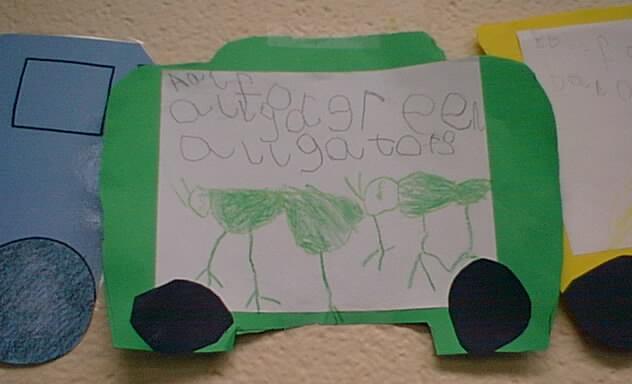
Brainstorm with students some different things that trains could carry. Next, ask them to consider what color each of those items would be. Tell students that throughout the week, they are going to work on making an ABC color train! Each student can contribute one sentence and train car. Write each sentence on chart paper, writing their name at the end of the sentence. (For example, 'Aa is for green alligators.' (Alan) ) Let a few students each day share their sentences. Reread each sentence tracking the print.
(You may wish to read a factual story about trains today as well!)
Day 2
Focus Story:
Ask students to share what they remember about yesterday's story; Reread The Little Engine That Could. Students will most likely want to chime in when the little blue engine says, "I think I can! I think I can!"
Companion Story:
Introduce the companion story Freight Train. Take a picture walk, letting students share what they know about each train car pictured (color, name, contents, etc.). Read the story aloud for enjoyment.
Predictable Chart:
Reread the sentences from yesterday. Encourage a few more students to add to the predictable sentence char, continuing with the next letter of the alphabet.
Day 3
Focus Story:
Review the focus story, The Little Engine That Could. Show students pictures from the story that are out of order. Let students look closely at each picture and describe what is happening. Encourage students to work together to place the pictures in order. As students place the pictures in order, discuss the beginning, middle, and end events. Also, let students determine what the problem in the story was as well as how the problem was solved.
Companion Story:
Reread Freight Train, pausing for students to fill in the appropriate color word.
Predictable Chart:
Reread all of the sentences contained on the chart from the previous days. Choose a few more students to think of an object that could go in our ABC color train. Write their responses, encouraging students to spell out loud the words 'is', 'for', and the color words.
Companion Story:
Introduce the title, author, and illustrator for another companion story called Clickety Clack. Read the story aloud. Ask students to think about what it would be like to be riding on the train with all of these creatures and to predict where they think the train is going.
Day 4
Predictable Chart:
In the same manner as previous days, continue to reread and add the last few sentences onto your class ABC color train predictable chart. If you do not have enough students to complete your ABC train, work as a class to think of some items that start with the missing letters.
Companion Story:
Reread Clickety Clack, pausing to let students fill in the rhyming words and the 'clickety clack's. Next, write the word 'clack' on the board and tell students that they will be going on a rhyme hunt for other words that rhyme with 'clack.' Reread the story, page by page, and let students listen for rhyming words. Have students raise their hands when they hear a word that rhymes with 'clack'. Then, students can assist you in writing that word. (See photo below.) In this manner, your class will be 'Rounding Up the Rhymes'!

Work with additional rhymes and word families by having students work in partners to put together word family puzzles. Students have to match the puzzle pieces, read the newly formed word, and then find the corresponding picture. (See below.)
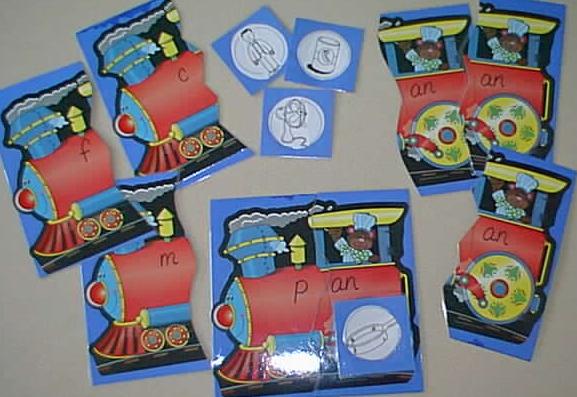
For individual practice with word family rhymes, let each student complete their own 'Word Family Train' booklet. (See below for photo and printables.) In the booklet, there are four word families, with three words from each word family. Students have to read the words on the train cars and then cut and glue the corresponding picture above each car.
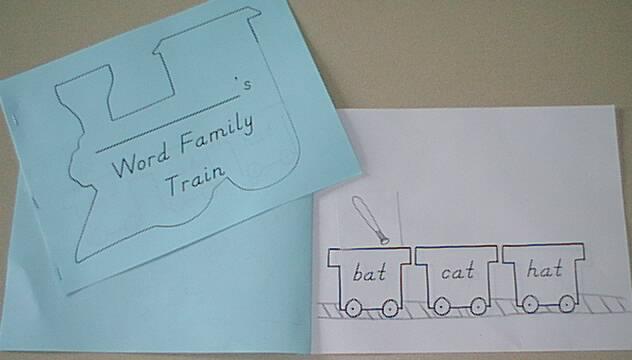
Printable Word Family Train Booklet in PDF format
(for at, et, ug, and op word families)
Note: You will still need the corresponding pictures! I found mine in Fun Phonics Manipulatives by Hancock, Pate, and VanHaelst, Scholastic, 1997 and cut and pasted to make sheets for each child.
Day 5
Focus Story:
Reread the story The Little Engine That Could. Encourage students to think and compare themselves to the little blue engine in the story. Then let students orally share one thing that they thought would be very hard to either do or learn in Kindergarten, but with practice they are now able to do it successfully - something they are proud of. (For example, some of my previous students were proud of making new friends, learning to tie their shoes, learning their ABC's, writing in their writing notebooks, etc.) As each child shares, pin a little blue engine to their shirt that says 'I can!' (Ours were cut using the ellison press.)
Companion Story:
Reread Clickety Clack, encouraging students to join in on the reading; Give each child a train (You might want to use the ones they have made- See below under cross curricular connections, Art) and a small plastic animal. Ask students to set their animal at the beginning of he train, at the end of the train, and then in the middle of the train. Say a word and ask students to listen carefully to where they hear a certain sound. and then ask students to place their animal to the side of the train car where they hear that sound (beginning, middle, or end).
Examples:
cat : /c/ = beginning
sun : /u/ = middle
mop : /p/ = end
Predictable Chart:
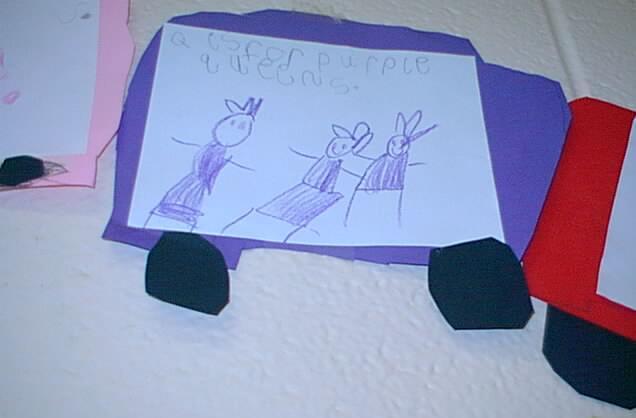
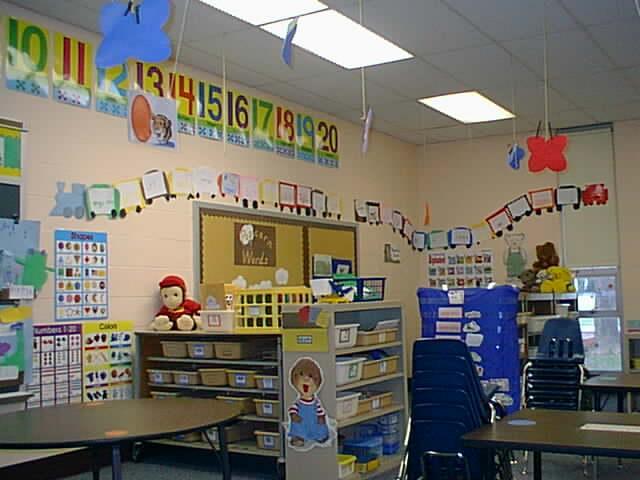
The ABC color train predictable sentence chart should have been completed during the previous days. Have each student come up and point to each word of their sentence as they read it aloud. Then, model for students how to copy their sentence onto their paper, draw a corresponding picture, and cut, glue their train car. (See some student samples below.)
Related Read Aloud Stories/Poems
Focus Story: The Easy To Read Little Engine That Could by Watty Piper
Companion Story: Clickety Clack by Rob and Amy Spence and Freight Train by Donald Crews
The Little Engine That Could by Watty Piper
Down By the Station by Will Hillenbrand
Inside Freight Train by Donald Crews
I'm Taking a Trip on My Train by Shirley Neitzel
Train Song by Harriet Ziefert
Chugga-Chugga Choo-Choo by Kevin Lewis
Little Red Caboose by Steve Metzger
This Train by Paul Collicutt (uses high frequency words 'this' and 'is' -- Great for early readers! )
The Train by David McPhail
Trains by Gail Gibbons
Trains by Anne Rockwell
Engine, Engine Number Nine by Stephanie Calmenson
A True Book of Trains by Darlene Stille
Trains Discovery Library by Lynn Stone (Titles in series are below.)
America's Railroads
Diesel Locomotives
Freight trains
Freight Yards
Passenger Trains
Steam Locomotives
Choo Choo Train
This is the choo-choo train. (bend arms at elbows)
Puffing down the track. (rotate arms in rhythm)
Now it's going forward,
Now it's going back,
Now the bell is ringing, (pull cord with closed fist "ding, ding")
Now the whistle blows. (hold hands around mouth "woo, woo")
What a lot of noise it makes,
everywhere it goes! (cover ears with hands)
A Peanut Sat on a Railroad Track
(Tune of Polly Wolly Doodle)
A peanut sat on a railroad track,
His heart was all a-flutter,
Round the bend came number ten,
Toot! Toot! Peanut butter!
Engine, Engine Number Nine
Engine, engine number nine,
Coming down Chicago line.
If the train falls off the track,
do you want your money back?
The Little Boxcars
(Tune of One Little, Two Little, Three Little Indians)
One little, two little, three little boxcars,
Four little, five little, six little boxcars,
Seven little, eight little, nine little boxcars,
All pulled behind the engine.
One little, two little, three little boxcars,
Four little, five little, six little boxcars,
Seven little, eight little, nine little boxcars,
All in front of the caboose…Toot! Toot!
Train
(Tune of The Farmer in the Dell)
The engine chugs along,
The engine chugs along,
Up and down the mountain tracks,
The engine chugs along.
The train goes click, click, click,
The train goes click, click, click,
Straight across the open plain,
The train goes click, click, click!
The whistle goes woo, woo,
The whistle goes woo, woo,
All across the USA,
The whistle goes woo, woo!!
Possible Cross Curricular Connections
Art:
1) Create milk box trains! (See samples below.)
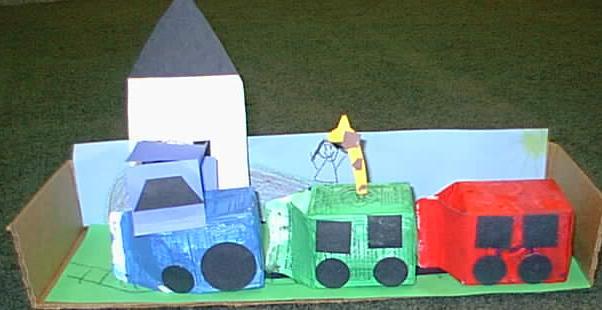
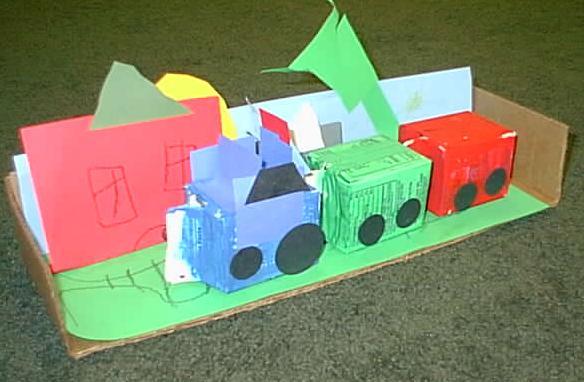
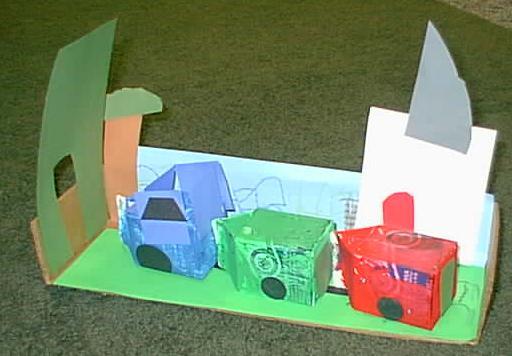
These trains are made from painted milk cartons. Students attached pre-cut circles and squares for wheels and windows and then decorated the rest of the train and the background as they desired. Most students added tracks, buildings, trees, etc. to their backgrounds. Some added tunnels, animals, etc. The background is just a box, left over from our school's pop delivery man, cut lengthwise. The three milk cartons are held together by a strip of black construction paper taped underneath the boxes. The students loved this project!
Thanks to Judy Reed for the idea to add the background using the boxes.
Math:
1) Place train cars in order from 1-__
2) Make 'Pattern Trains' from unifix cubes
Literacy:
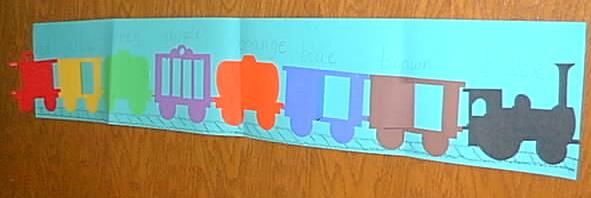
1) Form a color train (from ellison cut outs) and then write the corresponding color words(See below.)
2) Focus on rhymes
3) Word Family Focus '-ack'
4) Work with oral segmentation
5) Sequence
6) Create a predictable chart- '(Letter) is for (color) (word that begins with same letter).'
Social Studies:
1) Learn about the railroad and trains
2) Learn about different modes of transportation
3) Focus on the character trait of perseverance and trying/learning new things even when they may be tough
4) Discuss railroad safety/signs
Science:
1) Identify wheels used in a variety of ways
2) Investigate things that roll
Movement:
1) Sing and move to 'The Little Boxcars' (See in poem section above.)
Related Resources
Just Trains
Freight Train Take Home Activity Card - printable from Webbing Into Literacy
Various Modes of Transportation
Let's Go!- a transportation webquest