I Like Bugs!
by Margaret Wise Brown

Focus Story:
I Like Bugs! by Margaret Wise Brown
Companion Story:
The Very Hungry Caterpillar by Eric Carle
Day 1
Old Favorites: Reread charts/poems from previous stories
Prior Knowledge:
Ask students to share the types of bugs that they have seen before as well as where they have seen them. Do they like bugs? Why or why not?
Focus Story:
Introduce the author and illustrator of this week's focus story I Like Bugs. Show the cover. Let students use the pictures, read the 'popcorn' words 'I' and 'like', and decode the word 'bugs' in order to figure out the name of the story. Have students name bugs that they see on the cover.; Take a picture walk. According to the level of your students, encourage children to discuss each picture. Then, have them use the many 'popcorn' or high frequency words in the story, what they know about letters and sounds, and the picture cues on each page to work together and 'read' the story together.; Read aloud for enjoyment.
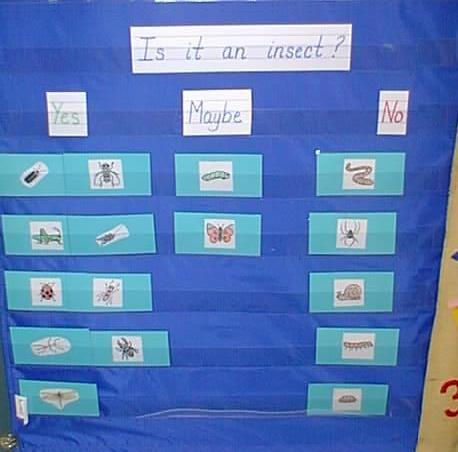
You may want to introduce a poem/song about insects or read a factual story about insects. Then have students sort bug pictures into three columns in order to answer this question. "Is it an insect?" (see photo below)
Day 2
Focus Story: Shared Reading- reread I Like Bugs having students be your echo for each page.
Companion Story:
Introduce title, author and illustrator of The Very Hungry Caterpillar;Take a picture walk and discuss all the foods the caterpillar is eating. Let them predict the name, number, and color of the upcoming fruit. How many of each fruit did he eat? W hat colors are the fruits? Is the tiny caterpillar eating healthy foods? Do you think this is what caterpillars really eat? Could a caterpillar really eat this much? What might happen to the caterpillar? How does the caterpillar feel after eating all of the food? How can you tell? End the picture walk once the caterpillar starts to change. Let students predict what might be happening to the caterpillar.; Read aloud for enjoyment and to see what finally happens to the caterpillar!
Science Connection:
Learn about real caterpillars and butterflies! Review what makes a bug an insect and read books such as Are You a Butterfly? to discover if a butterfly is an insect.
Day 3
Focus Story: Shared Reading - Reread I Like Bugs! encouraging students to join in the reading with you
Companion Story:
Review with students what happened in the story The Very Hungry Caterpillar; Shared Reading - Reread the story, dropping your voice and letting students read the repeated portions of the story; Introduce the companion retelling chart by having students put it together! Start by reviewing all of the days of the week words. Then, pass out a day of the week word to various students. Ask the student who has the first day of the week, Sunday, to place it at the top ofthe pocket chart. Then Monday and so on until all of the days of the week are sequenced. Next, review the numerals. Pass out the numeral cards and ask students to order those cards in a similar fashion. Show students the remaining cards and have them place the events in order (hatching from the egg, eating 1 apple, etc); Read the story chart with students.

Above: The completed Very Hungry Caterpillarretelling chart
Science Connection:
Read a book about the life cycle of a butterfly such as From Caterpillar to Butterfly. Then sequence pictures showing the various stages.
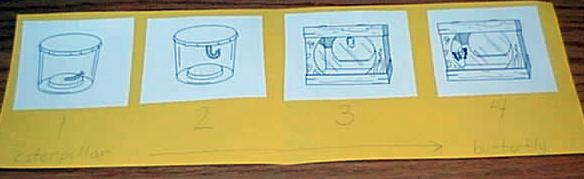
It would be a wonderful experience for children to be able to witness first hand the changes from caterpillar to butterfly in the classroom as well!
Day 4
Focus Story:
Reread I Like Bugs! -echo reading; Show bug pictures. Let students take turns drawing a bug picture card from the pile. Have them name the bug and tell the beginning sound. Then all students can sing 'Insect Parade', substituting the name of the bug and the beginning sound. (This idea is found in Spring Phonemic Awareness Songs and Rhymesby Jordano and Callella-Jones, Creative Teaching Press, 1998.)
Insect Parade
(tune: 'This Old Man')
This little butterfly sings /b/ songs.
He sings /b/ songs all day long,
with a bick-back-baddy-back.
Sing his insect song.
He wants you to sing along!
Companion Story:
Shared Reading - Reread The Very Hungry Caterpillar using the retelling pocket chart; Then, have students work to make a take home retelling booklet. (See below.) Students will need to write the numerals, use a hole puncher to make a hole in each fruit, and draw the caterpillar, cocoon, and butterfly.

(This booklet was created after reading an idea by Lisa Carter that she shared on the Eric Carle Website.) Printable Very Hungry Caterpillar Booklet (7 pages in PDF format)
Day 5
Focus Story:
Show bug pictures (same pictures as yesterday) one at at time. Let students name the bug and quietly hold up the number of fingers to show how many parts or syllables they hear in the word. Then, clap the number of syllables together in order to check.; Reread I Like Bugs! (You may see if students can read the book to you and you can be their echo! My students loved this!); Have students fill in the blanks below with descriptive words (color, size, number, etc.) in order to make a new 'buggy' poem. Then let each student illustrate to make their own booklet to share at home!
I like bugs.
______ bugs.
______ bugs.
______ bugs.
______ bugs.
I like bugs!
Related Bug/Insect Read Aloud Stories and Poems
Focus Story: I Like Bugs! by Margaret Wise Brown
Companion Story: The Very Hungry Caterpillar by Eric Carle
Bugs/Insects
Bug Watching by Rebel Williams
Bugs, Bugs, Bugs by Bob Barner
I Like Bugs by Margaret Wise Brown
Bugs, Bugs, Bugs by Mary Reid
Where Do Insects Live? by Susan Canizares
What Do Insects Do? by Susan Canizares
Bumblebee, Bumblebee, Do You Know Me? by Anne Rockwell
The Icky Bug Counting Book by Jerry Pallotta
The Best Bug Parade Ever by Stuart J. Murphy
In the Tall, Tall Grass by Denise Fleming
Ladybug's Birthday by Steve Metzger
The Insect Book: A Basic Guide to the Collection and Care of Common Insects for Young Childrenby Connie Zakowski
Bugs and Other Insects by Bobbie Kalman
Play and Find Out About Bugs: Easy Experiments for Young Children by Janice VanCleave
See How They Grow by Kimberlee Graves
Bugs! by Patricia McKissack
Spiders are Not Insects by Allan Fowler
Bugs!
(by Margaret Wise Brown)
I like bugs.
Black bugs,
Green bugs,
Bad bugs,
Mean bugs,
Any kind of bug.
A bug in a rug,
A bug in the grass,
A bug on the side-walk,
A bug in a glass --
I like bugs.
Round bugs,
Shiny bugs,
Fat bugs,
Buggy bugs,
Big bugs,
Lady bugs,
I like bugs.
Insect Bodies
(Tune: If You're Happy and You Know It)
By Victoria Smith
Every insect's body has three parts.
Yes, every insect's body has three parts.
Every insect has a head,
A thorax and abdomen,
Every insect's body has three parts.
Every insect's body has six legs.
Yes, every insect's body has six legs.
They have three legs on each side
And they walk on them with pride.
Every insect's body has six legs.
The Insect Song
(to the tune of London Bridge)
by M. Hubbard
Every insect has 3 parts.
has 3 parts.
has 3 parts.
Every insect has 3 parts.
And I can name them all!
Head and thorax, abdomen.
abdomen.
abdomen.
Head and thorax, abdomen
An insect has 3 parts!
Every insect has 6 legs.
has 6 legs.
has 6 legs.
Every insect has 6 legs.
Count them all to see.
Every insect has antennae.
has antennae.
has antennae.
Every insect has antennae.
That is how they smell.
Insects usually have some wings.
have some wings.
have some wings.
Insects usually have some wings.
That is how they fly!
Every inset has 3 parts
has 6 legs.
and antennae.
Every insect has these things.
Some even have wings!

Butterflies/Caterpillars
From Caterpillar to Butterfly by Deborah Heiligman
Monarch Butterfly by Gail Gibbons
Waiting for Wings by Lois Ehlert
Charlie the Caterpillar by Dom Deluis
Butterfly Magic by Melissa Getzoff
The Very Hungry Caterpillar by Eric Carle
Are You a Butterfly by Judy Allen
See How They Grow: Butterfly by Mary Ling (Dorling Kinersley, Inc.)
Butterfly, Butterfly
(as posted at Teachers.net by Jill/K/OK)
Butterfly, butterfly, fly away.
Butterfly, butterfly, don't delay.
Butterfly, butterfly, fly so high.
Butterfly, butterfly, touch the sky.
Butterfly, butterfly, turn around.
Butterfly, butterfly, touch the ground.
Butterfly, butterfly, quick as a wink.
Find a (color) flower and stop to drink.
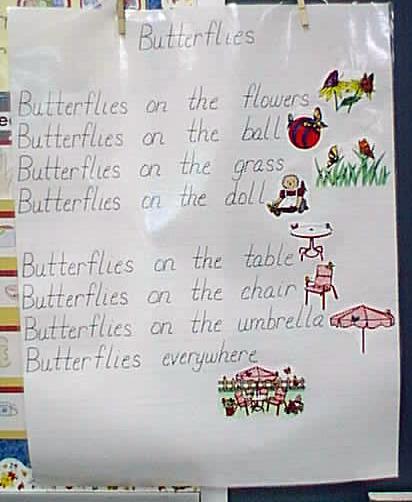
Above: Poem and pictures are from Totline "Take-Home" Books: Reproducible Pre-Reading Books for Young Children by Jean Warren, Warren Publishing: 1990.

Ants
Hey, Little Ant by Phillip Hoose
One Hundred Hungry Ants by Elinor Pinczes
The World of Ants by Melvin Berger
Ant Cities by Arthur Dorros
If You Were an Ant by S.J. Calder
I Can't Said the Ant by Polly Cameron
Two Bad Ants by Chris Van Allsburg

Ladybugs
Very Grouchy Ladybug by Eric Carle
Ten Little Ladybugs by Melanie Gerth
The Ladybug and Other Insects (First Discovery Book) by Pascale De Bourgoing
Are You a Ladybug? by Judy Allen
Ladybug, Ladybug by Ruth Brown
Ladybugs!
(Author Unknown)
Ladybugs all dressed in red,
Strolling through the flower bed.
If I were tiny, just like you...
I'd creep among the flowers too!
I'm a Little Ladybug
(Tune: I'm a Little Teapot)
(Author Unknown)
I'm a little ladybug, as you can see.
I am a beetle, pretty as can be.
I am brightly colored, red and black.
Look at the pretty spots on my back!
Possible Cross Curricular Connections
Art:
1) Make the TLC caterpillar, ant, and ladybug in Beginning Lessons

2) Create butterfly hangings – use wax paper, crayon shavings, iron, cut, mount between butterfly cut out
3) Paint a large cut out of a butterfly.
Math:
1) Focus on measurement
2) Play Bug Jar Math (matching numerals to sets and simple addition)
3) Focus on counting and beginning addition using ladybug halves.

Printable Ladybug Math Sheet (in PDF)
Corresponding Ladybug Recipe (scroll down)
4) Make bugs and flowers counting cards and have students record their answers on the Flower Recording Sheet (If you place the bugs in groups of fives on the counting cards, then you could also have students cut and order their flower sheets to count by 5's.);

Above: Counting Cards
5) Butterfly Symmetry – Use pattern blocks to duplicate one half of a butterfly and then create symmetrical torn paper butterflies (This idea and pattern block reproducible can be found in Exploring Patterns in Math and Beyond by Betsy Frano, Scholastic: 1999);

Literacy:
1) Word Family Focus –ug (have students manipulate lettersto form -ug words and then read a reproducible -ug word family mini booklet. I found one in Reading Success Mini -Books: Word Families by May Spann, Scholastic, 1999)
2) Match rhyming ladybug halves! (See below.)
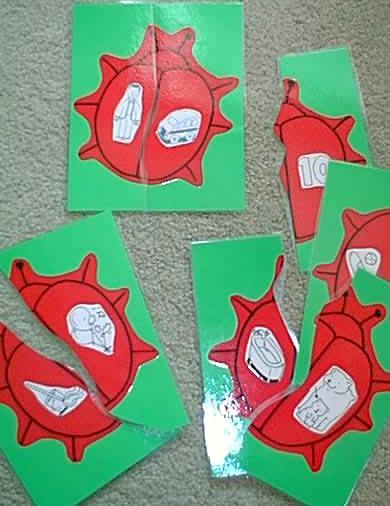
3) Reproduce a simple insect booklet (such as is found in More Little Books to Make and Read by Dunlavy and Caroll, Good Apple, 1996) and have students cut, order, bind, and read the booklet
4) Play Bug-o! Bingo to practice letter recognition and sound correspondences
Science:
1) Learn what makes an insect an insect and how insects can be helpful
2) Make an ant hill and add the ants in their chambers (a great idea from the PKC staff)

3) Make and eat marshmallow ants, stressing the body parts
4) Study the life cycle of a butterfly and sequence pictures showing its growth
Related Resources:
Insects
Birds, Bats, and Bugs Printable Notebook - from Hubbard's Cupboard/Joyful Heart Learning
Insects - lots of ideas from Teaching Is a Work of the Heart
Insect Related Cooking Projects
Insect Poems- various
Paper Mache Insects!
Insect Art
Printable Bugs- lots of bugs to print out and a different Bug-go Game
Butterflies
Butterflies and Caterpillars- from Enchanted Learning
Butterfly Poems- from Can Teach
Monarch Butterfly Cycle Photos!
Butterfly Life Cycle- printables
Very Hungry Caterpillar Lessons- from Webbing Into Literacy
The Very Hungry Caterpillar - ideas from The Virtual Vine
Very Hungry Kindergartner Book
Ants
Ants!- lots of information!
Ladybugs
Ladybug Poems- from Can Teach
The Grouchy Ladybug - ideas to accompany the book, from Vicki Blackwell