
Family Night
(If You Give a Mouse a Cookie)
One evening during the school year, families are invited to return to school with their kindergartner to experience a special evening of games, food, crafts, and fun --with a focus on the joy of math, literacy, and learning as a family!
By participating in our Family Night, it is my hope that ...
- students will exhibit an increasing excitement in regards to the areas of math and literacy learning.
- students will see evidence of their families' support for their learning and school environment.
- families will experience the fun of learning alongside their child.
- families will develop a greater awareness of ways to assist their child in acquiring math and literacy skills.
- families will gain insight into the kindergarten level mathematics and literacy program.

If You Give a Mouse a Cookie
Our Family Math and Literacy Night in the spring was a huge success! Families of students in both the AM Kindergarten and Extended Day class were invited to attend this special evening. All of our activities for the evening were centered around the book If You Give a Mouse a Cookie by Laura Joffe Numeroff. Kindergarten students and their families participated in math games, literacy activities, crafts, and a create a snack project.
Family Night Take Home Pack
Schedule
Activities
Printables
Additional Resources
Family Take Home Pack
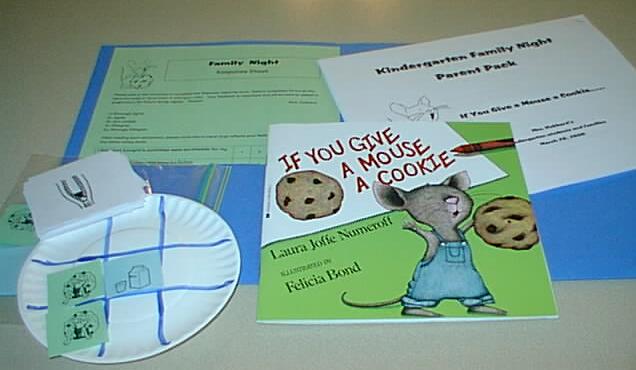
Each family in attendance received a folder containing directions for each activity set up during the evening of the Family Night, ideas for extensions at home, coordinating math/literacy skills and concepts taught within each activity, a take home game, and a feedback form. Each kindergarten student who brought their family also received their very own copy of the book If You Give a Mouse a Cookie to read again and again!
Return to Top
Family Night Schedule

6:45-7:00 - Arrival/Transition
Sign in siblings with childcare (Room 2)
Pick up a Parent Pack (Gross Motor Room)
'What do you like?' Venn Diagram
Play Mouse ABC Tic-Tac-Toe (as time allows)
7:00 - Welcome!
Purpose
Enjoy a story- If You Give a Mouse a Cookie
Procedures for the evening
7:10 - Participate in mouse and cookie stations with your family!
7:55 - Winner of cookie estimation announced
Family Night Activities
See what activities and skills students participated in with their families!
Mouse ABC Tic-Tac-Toe
Why: To practice identifying the letters at the beginning of pictures
How:
(Note: You may keep this game if you wish so that you can play again and again at home! It is a game that can be played with 2 people or with 2 teams.)
1) Lay the picture cards face down in a pile.
2) Let one team be the cookie and the other team be the milk.
3) On your turn, turn the top picture card over, say the name of the picture, and then say what letter the picture begins with. If you are correct, you may place one of your team's playing pieces on the tic-tac-toe plate. If you are not correct, then you do not get to place a piece down for your team.
4) Play alternates between teams.
5) To win, a team must get three in a row and then say 'Tic-Tac-Toe!'
Cookie Estimation
Why: To develop beginning estimation
How:
(Note: There are three related activities at this station. They may be completed in any order.)
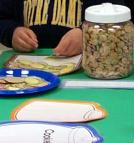
1) Look closely at the three jars with mini cookies. Without counting, which jar do you think has the most/least cookies inside? Move the numeral cards to reflect your prediction. Then lift the flap to show the number of cookies in each jar. Which jar really did have the most/least? What might have made this difficult to determine?
2) Look at the largest jar containing mini cookies. Each family may make 1 prediction as to how many cookies are in this jar. Write your families' prediction (number guess and first and last name) and then place it in the can. (You may win a prize if your families' estimate was the closest!)
3) Choose 1 paper cookie jar. Estimate how many paper cookies will be able to fill the cookie jar. Once you have told someone your estimate, start placing cookies on the jar until it is completely filled. Count to see how many cookies filled the cookie jar!
Cookie Jar Math
Why: To make sets of objects to correspond with numerals (1-20); to use objects to add and subtract

How:
(Note: There are two different activities at this station.)
1) Choose a cookie jar that has a numeral on the lid. Read the number out loud and then count that many cookies into the jar.
2) Choose a cookie jar without a numeral on the lid. Have an adult read a short story problem. As the story is being read, place that many cookies in the jar. Listen carefully. You may need to add more cookies into the jar or take some cookies out of the jar based on what happens in the story. At the end of the story, you will need to count and tell the adult how many cookies are left in your jar.
Use the copied cookies and the jar pattern to solve the following story problems.
1. Today, Mike the mouse ate 4 cookies for breakfast and 5 cookies for dinner. How many cookies did he eat today?
2. Yesterday, Mike gave 3 cookies to each of his 4 friends. Count the total number of cookies he gave to his friends.
3. Mike was playing king of the cookie hill with 7 cookies. He accidentally knocked 2 cookies on to the floor. How many cookies did he have left?
4. Mike hid 2 cookies in the heat duct and 3 cookies under the couch. How many hidden cookies did he have to secretly eat later?
5. Mike wanted to make a fort out of cookies. It took 3 cookies for a door and 8 cookies for the main room. How many cookies did it take to make the entire fort?
6. Mike was using 6 cookies to practice discus for the Mouse Olympics. After several times throwing each cookie, 4 of them fell apart. How many whole cookies were left?
7. Mike invented the cookie-o-matic cookie-making machine that could make 4 chocolate chip cookies and 6 peanut butter cookies in one minute! How many total cookies could the machine make each minute?
8. On Mike's birthday, the mice played drop-the-cookie-on-the-tray. Mike was blindfolded and was given 5 cookies. He only got one on the tray (he "accidentally" dropped the others in his mouth). How many cookies were not on the tray?
Cookie Patterning
Why: To practice identifying, copying, and making AB, AAB, ABC, & ABB patterns

How:
(Note: There are three patterning activities at this station that progress in difficulty.)
1) Choose 1 pre-made cookie pattern strip. Place the exact same cookie cutouts on top of the pattern strip. Can you continue with the same pattern off the edge of the strip? Recheck your pattern by going back to the beginning and pointing to each cookie. Either say the color or letters for the pattern!
2) Use just the cookie cut outs to layout and form your own pattern. Tell an adult what your pattern is or see if they can guess your pattern.
3) Use crayons and the cookie outline sheet to color and create your own pattern. Make sure to tell someone your pattern and check it!
Cookies on My Plate
Why: To practice making sets of objects to correspond with numerals (4-10); to join sets of objects and count how many there are in all

How:
1) Choose what number you want to work with (4, 5, 6, 7, 8, 9, or 10) and count out that many beans.
2) Shake and roll the beans.
3) Count the red beans. Draw that many cookies on 1 half of your plate and write the numeral to show how many you have.
4) Count the white beans. Draw that many cookies on the 2nd half of your plate and write the numeral to show how many you have.
5) Count how many you have all together. Draw that many cookies on the full plate and write the numeral to show how many you have in all.
Favorite Cookies
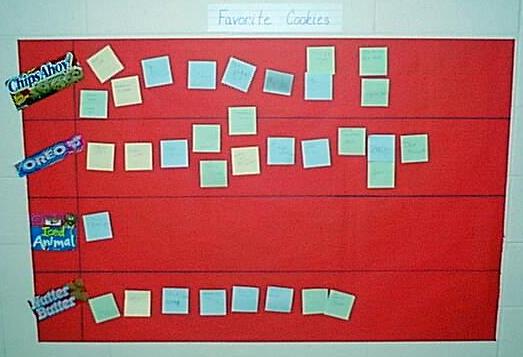
Why: To practice counting how many are in a set; to compare sets and determine which has more or fewer items
How:
1) Each family may take one bag of cookies.
2) Determine how you can share the cookies in your bag evenly with all family members who are present.
3) Once your bag of cookies are divided evenly, eat your cookies.
4) Let each person in your family decide which cookie was his/her favorite.
5) Each person in your family needs to write their first and last name on a sticky note and place the sticky note on the graph to show which cookie was their favorite.
6) Look at the graph. Discuss which cookie was liked more than the others, less than the others, and which ones are liked the same amount. You may want to check back a little later to see if the graph has changed.
Create a Snack
Why: To practice following directions; to reinforce that print has meaning; to practice tracking print left to right

How:
(Note: Each person in your family may make a 'Create a Snack'.)
1) Take 1 napkin.
2) Using the spoons provided, place each of the following on your napkin…
1 Townhouse cracker, 2 Ritz Bitz sandwich crackers, 2 raisins, 1 chocolate chip, 1 Cheerio
3) Use a knife to spread a thin layer of peanut butter onto your Townhouse cracker.
4) Slip the edges of the 2 Ritz Bitz crackers over the Townhouse cracker. (These are the ears!)
5) Place the 2 raisins on to be the eyes, the chocolate chip to be the nose, and the Cheerio to be the mouth.
6) Eat and enjoy!
7) Throw all of your crumbs, napkins, etc. away before leaving for the next station = )
Mouse Puppet
Why: To increase fine motor skills; to practice retelling a story using pictures

How:
(Note: You may take one set of story pictures home with you if you do not have time to complete this project here.)
1) Trace a mouse head pattern onto gray construction paper. Then cut it out.
2) Use the smaller pieces of construction paper to add ears, eyes, nose, and whiskers to the mouse head.
3) Cut out a pair of overalls and color as desired.
4) Glue the mouse head and overalls onto a brown lunch sack.
5) Color and cut out the story pictures.
6) Use the mouse puppet and the story pictures to retell If You Give a Mouse a Cookie to someone else!
ABC Mice
Why: To reinforce letter recognition; to match upper and lower case letters; to practice identifying the letters at the beginning of pictures

How:
1) Choose one of the three sets of mice and cookies to work with first.
2) Put the cookie puzzles together by matching the upper and lower case letters. (A with a, B with b, etc.)
3) Look at the pictures on the mice. What letter does each picture start with? Match each mouse to the correct letter cookie.
4) Return all cookie pieces and mice to the correct bag when finished.
Write a Story
Why: To practice letter formation and letter/sound associations ; to encourage creativity by drawing/writing a variation to a known story
How:
1) Choose either a mouse or cookie shaped paper.
2) Read the sentence, "If you give a mouse a _____, he'll want a ____ to go with it!"
3) As a family, figure out what you could give a mouse and then what he would want to have to go with it.
4) Help your child to stretch out the sounds of the words with you and to try to write the beginning and ending letters they hear (like in our kid writing and writing notebooks) on the blank lines.
5) Make an illustration to go with your story.
Family Photo
Why: To help us remember the fun we had at our Kindergarten Family Night

How:
(Note: I will send home the photo of you and your family after Spring Break. We will also keep a copy in the classroom as part of a Family Night class book.)
1) Read the chart near the mouse and fill in your family members' names where the blanks are.
2) Gather your family around the 'If You Give a Mouse a Cookie' mouse.
3) Ask the photographer to take your family photo.
4) Write the names of the family members who were in the photo with the mouse and leave this information with the photographer.
Who Took the Cookies?
Why: To practice matching numerals to sets; oral language

How:
1) Sit on a carpet square.
2) Look at the words in the pocket chart and chant… (Students should be able to teach you this one!)
3) As you chant "Who took the cookies from the cookie jar?" roll the die.
4) The person who is sitting in front of the corresponding numeral gets to chant "Who me?" and the "Not me" portion. At the end, they get to roll the die for the next round.
Mouse Listening Maze
Why: To practice good listening; to sequence events from a story
How:
1) Take one mouse maze sheet and a pencil.
2) Find 'start' on your maze. You will be drawing a line to different pictures as you listen to the story and follow the mouse.
3) Press 'play' on the tape recorder.
4) Please rewind the tape when finished listening.
Cookie Count
Why: To match numerals to sets; to practice using one to one correspondence
How:
(Note: This game can be played with 2 or more people.)
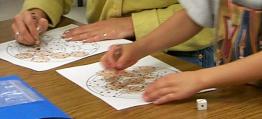
1) On your turn, roll the die and then use a crayon to color in that many cookies on your cookie plate.
2) Play alternates between players.
3) The first person to fill their cookie plate wins!
Printables for 'If You Give A Mouse a Cookie' Family Night
(Designed by Hubbard's Cupboard)
Sample First Invitation
Sample 2nd Invitation with RSVP
Parent Pack
Sign In Sheet
Mouse Writing Sheet
Cookies on My Plate Sheet
Create Your Own Cookie Patterning
Estimation Jar Slips
Links to Additional Ideas for If You Give a Mouse a Cookie
Lesson Plan for Pre-K
Lesson Plan for Grades 1-3
Related Activities
Lesson Ideas from Teaching is A Work of the Heart
Lesson Ideas from The Virtual Vine (also has ideas for other books in this series!)
Math Story Problems