
Caps for Sale
by Esphyr Slobodkina

Focus Story:
Caps for Sale by Esphyr Slobodkina
Companion Story:
Five Little Monkeys Sitting in a Tree by Eileen Christelow
Companion Poem:
'Monkeys, Monkeys'
Day 1
Old Favorites: Reread charts/poems from previous stories.
Prior Knowledge:
(Before beginning this week's focus story, send home a note to families requesting that they let their child bring/wear their favorite cap to school on this day.) Let each child use a complete sentence to state why that particular hat is their favorite. Have students sort the type of caps that they wore to school today (by color, by sports teams, by logos/emblems, etc.) Discuss different reasons for why we wear caps.
Focus Story:
Introduce title, author and illustrator; Show the cover and discuss what a 'peddler' is and what the peddler might be selling. Take a picture walk being sure to discuss what is happening in each of the pictures. Below are some sample questions to get you started...
- How would you describe the peddler's caps? (color, number of each, all together)
- Show how you would have to walk with that many caps on your head.
- Where is the man going? What is he doing?
- Do you think it is safe for him to sleep with all those caps on his head? What might happen?
- What do you notice that is different about the peddler when he wakes up?
- What do you think happened to the other caps? Why?
- Where are his caps? How many monkeys are there? How many caps?
- What do you think the peddler will do?
- How could he get his caps back? How would you get your caps back?
- What is the peddler doing?
- What do you notice the monkeys doing?
Make sure to stop the picture walk right after monkeys shake their fingers back at the peddler. Ask students to predict what they think will happen next; Read aloud for enjoyment and to see how the peddler eventually regains all of his caps.
Companion Rhyme:
Introduce the companion poem 'Monkeys, Monkeys' (See below);Read together and and let students manipulate the caps and color words.

(Words and activity for 'Monkey, Monkey' are taken from Building Literacy With Interactive Charts by Schlosser and Phillips Scholastic:1992)
Day 2
Focus Story:
Reread Caps for Sale, encouraging students to join in on the repetitive parts. (They also greatly enjoy being the monkeys and copying the actions of the peddler!) Show students the 'sound monkeys' hanging from the trees (below). Ask students to name the pictures. You may wish to either have students sort the pictures by how many sounds they hear in each word or choose two pictures to focus on and ask students which one has the most sounds.
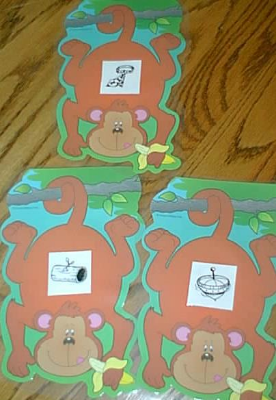
Examples:
tie : /t/ /i/ = 2
log : /l/ /o/ /g/ = 3
top : /t/ /o/ /p/ + 3
nest : /n/ /e/ /s/ /t/ = 4
(The idea and clip art for this activity originated from the book Phonemic Awareness Activities For Early Reading Success by Wiley Blevins. (Scholastic, 1997). ISBN 0-590-37231-9.)
Companion Rhyme:
Reread 'Monkeys, Monkeys', letting students manipulate the caps and color words similar to yesterday.
Companion Story:
Introduce the companion story Five Little Monkeys Sitting in a Tree.(Who do you see? Who are the monkeys teasing this time? Do you think that is wise to do?); Read the story aloud for enjoyment.
Day 3
Focus Story:
Reread Caps for Sale, encouraging students to join in on the repetitive parts. Show students pictures from the story. Review the story, having students work together to sequence pictures from the story to show what happened first, second, third, next, etc. Continue work with the 'sound monkeys' from yesterday.
Companion Story:
Reread the story Five Little Monkeys Sitting in a Tree, encouraging students to read with you.; Introduce the Five Little Monkey retelling chart 'Little Monkeys'(See below.). Let students manipulate the monkeys and number words.

(The idea for the 'Little Monkeys' is foundin Building Literacy With Interactive Charts by Schlosser and Phillips Scholastic:1992. The book also contains the reproducible monkeys.)
Day 4
Focus Story:
Let students act out Caps for Sale! You will need one peddler and a lot of monkeys! Also, have students work together to match up monkeys and their corresponding rhyming bananas. (See below.)

(Monkey and banana reproducibles can be found in The Best of the Mailbox: Learning Centers for Preschool and Kindergarten. (The Education Center, 1996) ISBN 1-56234-149-9)
Companion Story: Reread the Five Little Monkeys Sitting in a Tree retelling chart 'Little Monkeys.'
Day 5
Focus Story:
Let students act out Caps for Sale! You will need one peddler and a lot of monkeys! (similar to yesterday)
Companion Story:
Reread the Five Little Monkeys Sitting in a Tree retelling chart 'Little Monkeys.' Then, have students mask letters such as u, q, c, t, m and small words such as 'up', 'in', 'as', 'can', 'be'.
Related Read Aloud Stories/Poems
Focus Story: Caps for Sale by Esphyr Slobodkina
Companion Story: Five Little Monkeys Sitting in a Tree by Eileen Christelow
Companion Poem: 'Monkeys, Monkeys'
Five Little Monkeys Wash the Car by Eileen Christelow
Five Little Monkeys Jumping on the Bed by Eileen Christelow
Five Little Monkeys With Nothing To Do by Eileen Christelow
Don't Wake Up Mama! by Eileen Christelow
Curious George (series) by Margret andH. A. Rey
Counting Crocodiles by Judy Sierra
Monkey See Monkey Do by Marc Gave
Monkey See, Monkey Do : An Animal Exercise Book for You! by Anita Holsonback
Monkeys by Susan Canizares
Monkeys and Apes: A First Discovery Book by Gallimard Jeunesse and Janes Prunier
Possible Cross Curricular Connections
Art:
1) Create a scene from a favorite 'monkey' story (write and illustrate)
2) Make a monkey paper bag puppet
3) Create different types of caps and hats (related to careers or just for fun!)
Math:
1) Learn the name and value of different coins (up to 50 cents) - How many pennies (nickels, dimes, quarters) would it take to make 50 cents?
2) Make monkey patterns (See below.)

(The above monkeys were copied from The Mailbox Superbook for K. (The Education Center, 1998). ISBN 1-56234-196-0)
Literacy:
1) Word Family Focus 'ap'
2) Sight Word Focus 'the'
3) Create a predictable chart for 'I can sell______.' or 'A ___ sells _____.'; rhyme
4) Sequence
Social Studies:
1) Discuss the peddler's job and other types of jobs
2) Learn about wants and needs and ways to earn money
Science:
1) Learn about real monkeys!
Movement:
1) Play a 'Monkey See, Monkey Do' game. Place all student names in a cap. Pull out one name card and let the student stand in front of the class and perform an action. Then let all other students chant, "Peddler, peddler, who do you see?" The 'peddler' or student in front chants back, "I see monkeys______ing just like me!" Then all students (monkeys) begin copying the peddler's actions a set number of times!
Cooking:
1) Make and eat banana treats
RelatedResources
Fingerprint Monkeys and Monkey Pops -ideas from Delightful Learning
Caps For Sale Printables Pack - free from Homeschool Creations
Ten Little Monkey Rebus Rhyme- from Enchanted Learning
Caps For Sale Ideas - posted by Jill Davis on the Teachers.Net Lesson Exchange