Brown Bear, Brown Bear, What Do You See?
by Bill Martin, Jr.

Focus Story: Brown Bear, Brown Bear, What Do You See by Bill Martin, Jr.
Companion Story: I See Colors by Rozanne Lanczak Williams
Companion Poem: 'Teddy Bear, Teddy Bear'
Day 1
Focus Story:
Introduce the title, author and illustrator of Brown Bear, Brown Bear, What Do You See?. Ask students to look closely at the cover. Ask students to think about what a brown bear might see. Show students the inside cover and ask them to name the colors that they see. How might the colors be related to what the bear will see? Take a picture walk and encourage students to talk about the animals and the colors that they see. Ask students to say what they see in complete sentences, " I see a (color) (animal)." When the students see the picture of the blue horse, stop and ask them if they have ever seen a real horse. What color was it? Can a horse really be blue? Do they think this is a real or make believe story? Tell students to be on the lookout for more colored animals that the author and illustrator imagined. Were the animals in the book what the students thought the brown bear might see?
Read aloud the story, allowing students to chime in once they are familiar with the repetition of the words. Ask students what the brown bear saw. Did he see all of the animals in the story?
Show students a mural with trees, a house, a barn and fenced in barnyard, and a pond. Flip through the pages of the story, helping students to review which animals saw each other. (exp. brown bear looked up and saw red bird, red bird looked down and saw yellow duck, etc...) As you review, ask students to place cut outs of each animal in a place on the mural where it might really be found (and close to the animal that saw it!) (Please note: This activity is an adaptation of an idea from the Eric Carle bulletin board.)
Day 2
Focus Story:
Reread the focus story, Brown Bear, Brown Bear, What Do You See?, encouraging students to join in on the repetitive phrases. For phoneme discrimination, ask students to listen to the following names of animals from the story, Brown Bear, Brown Bear, What Do You See? Do the animal names contain the same beginning sound?
- bear/bird - yes
- duck/cat - no
- dog/duck - yes
- fish/frog - yes
- horse/sheep - no
Point children's attention to the mural from yesterday. Remind students that yesterday they had to work to remember the order the animals saw each other to complete the mural. Today, they need to remember the same order - because they will be the animals! Choose students to play the part of the animals from the story and give each one a necklace depicting an animal. Students not chosen will get to be the children shown at the end of the story who name all of the animals they see! Let all students say the first line of the story together. When the student wearing the brown bear necklace hears the word bear, he or she stands up and goes to the front of the room. The brown bear then says the next line in the story and the red bird takes his/her place next to the bear. Continue through the end of the story...
- All Students : "Brown Bear, Brown Bear, what do you see?"
- Bear: "I see a red bird looking at me!"
- All Students: "Red bird, red bird, what do you see?"
- Red Bird: "I see a yellow duck looking at me!"
- continue until the part of the teacher is reached
- All Students: "Teacher, teacher, what do you see?"
- Teacher: "I see children looking at me!"
- All animals: "Children, children who do you see?"
- Children not chosen as animals: "We see a brown bear, a red bird, a yellow duck..."

The character necklaces were made from printing the pictures available at DLTK.
Companion Story:
Introduce this week's companion story, I See Colors by Rozanne Lanczak Williams. Take a picture walk, asking students to state what color they see. Call on students to also orally share, in a complete sentence, an object that they see. For example, " I see a red jump rope." Return to the front cover and read the story all the way through with the students. Brainstorm additional things that are red and items that are blue (exp. Red - apple, tomato, stop sign, etc.).
You may wish to share the corresponding color poems for the colors red and blue at some point today, as time allows.
Begin the 'I See Colors' take home booklet, by completing the first two pages with students. Students write their own name two times, draw an object for each color, and use kid writing to write the name of each object.

Printable I See Colors Booklet
Cover
Bottom Page
Inside Sheets
Note: Copy the 'Cover' and 'Bottom' pages onto the same color of paper. Copy the 'Inside Sheets' onto plain white paper. Cut apart the 'Inside Sheets' and staple to the back page in the order the colors are mentioned in the lessons.
Companion Poem:
Read the companion poem, 'Teddy Bear, Teddy Bear' to students. Reread and have students move just like the bear!

Day 3
Companion Poem:
Reread 'Teddy Bear, Teddy Bear' with students as you point to each word. Reread again, allowing students to do the same actions as the bear.
Focus Story:
Explain to students that they will make a class book called Teddy Bear, Teddy Bear, Who Do You See? Have students sit in a circle, along with a stuffed teddy bear (we had a teddy bear called our share bear that I used). Have the students ask the Teddy Bear who he sees."Teddy bear, teddy bear, who do you see?" Speak for the bear and say that he sees you. " I see Mrs. Hubbard looking at me." Model for students how the teddy bear would write his name two times at the top of his page, and then (pretend to) draw a picture of himself. Write your name on the bottom line. Then have students ask you who you see. "Mrs. Hubbard, Mrs. Hubbard, who do you see?" State that you see the child sitting next to you. "I see Alec looking at me." Model again how to complete the book page. Continue having students ask the next child in the circle who he/she sees. If this is done at the beginning of the school year, let students write their own name at the top twice, but write the other child's name at the bottom of the page for the students.
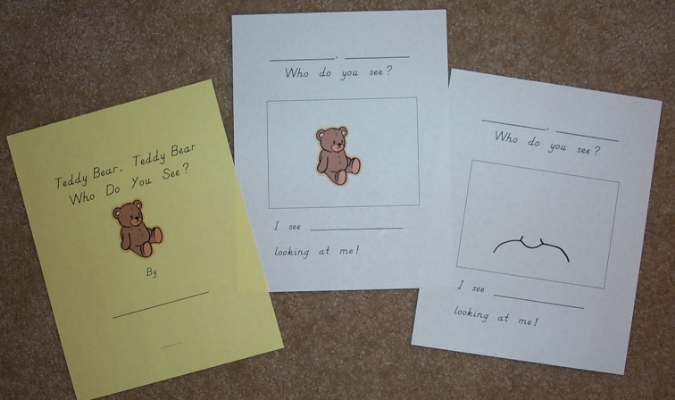
Printable Teddy Bear Teddy Bear Name Booklet
Syllable Sort - Let students take turns drawing a card of one of the characters from the story. Have them orally state the name of the character and then have the entire class say the name and clap the number of syllables they hear. Sort the picture cards by the number of syllables heard in the name of the character.
1 syllable : bear, bird, duck, horse, frog, cat, dog, sheep
2 syllables : goldfish, teacher, children
Companion Story:
Let students match the colors on the pages of I See Colors to color words. (Beforehand, cover the color word in the book and then let students attach the sentence strip color word to the correct page in the book using sticky tack.) Once completed, reread I See Colors with the students.

You may wish to share the corresponding color poems for the colors yellow and green at some point today, as time allows.
Continue working on the 'I See Colors' take home booklet, by completing the next two pages with students. Students draw an object for each color and use kid writing to write the name of each object.
Day 4
Companion Poem
Reread the chart poem ' Teddy Bear, Teddy Bear' and have students do the corresponding movements. Also, you may wish to read the book Teddy Bear, Teddy Bear by Michael Hague.
Focus Story:
Read the class made name book, 'Teddy Bear, Teddy Bear, Who Do You See?' with students.
Oral Blending - Stretch out the names of the animals or color words from the actual story (as well as names of students from the class made book)!. Let students listen carefully and put the words together to say the full word. Here are a few samples...
/b/ ear = bear
/p/ ink = pink
/sh/ eep = sheep
/r/ ed = red
/J/ im = Jim
Choral read Brown Bear, Brown Bear, What Do You See? .
Companion Story:
Divide the class in half, letting each half take turns reading the words on every other page of I See Colors. Let students watch as you write out one of the sentences from the story, cut the words apart, and mix them up. Give three students one word each so that they will 'Be the Words' and rearrange themselves to remake the sentence in the correct order. Follow the same procedure with other sentences from the story.
You may wish to share the corresponding color poems for the colors orange and brown at some point today, as time allows.
Continue working onthe 'I See Colors' take home booklet, by completing the next two pages
Day 5
Focus Story:
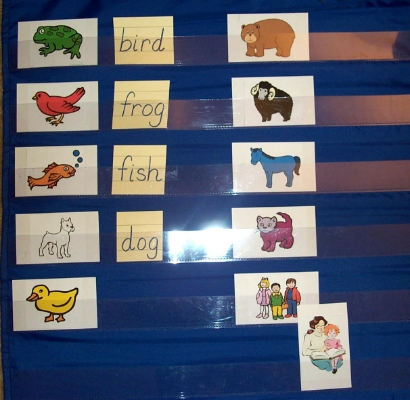
In a pocket chart, place pictures of characters from the story. Along the chalk ledge, place the names of each character written on sentence strips. Encourage students to listen carefully to the sounds heard as the name of acharacter is chosen and orally stated. Students will need to look closely at the letters in the names in order to match the pictures to the name cards. You can also have students match the color words to the animals.
Give each student their own set of Brown Bear, Brown Bear What Do You See? character picture cards. Have students sequence the character pictures. Then have them hole punch the top of each card and sting the characters, alternating with beads to form aretelling necklace.(This idea originated from the sharing of teachers on the Teachers.net chatboard.) Once completed, let all students retell the story, using their character necklace to help guide them!

Companion Story:
For shared reading today, let volunteers point to the words in the big book I See Colors as the class reads along with them.
You may wish to share the corresponding color poems for the colors purple and black at some point today, as time allows
Finish working onthe 'I See Colors' take home booklet, by completing the last two pages. Let students reread their completed booklets, each pointing to the words in their individual booklets as they read.
Companion Poem:
Read and move to 'Teddy Bear, Teddy Bear.' Ask students to share any rhyming words that they hear in the poem. As time allows, create new rhyming actions for the teddy bears to perform. See if students can spy out the new rhyming words. (For example - tap your nose/ touch your toes , jump up twice/roll some dice).
Possible Cross Curricular Connections:
Math:
- Sort objects such as colored cubes, links, etc. by color
- Give each child a small bag of edible items such as M & M's, Starbursts, jellybeans, Trix cereal, etc. to sort by color. Then have students make a bar graph of the number of each color they have.
- Let students bring their favorite stuffed bear from home to celebrate a 'Bear Buddy Day'! Students do math activities with their bears such as button counting on the bears tummy, button sorting, sorting the bear buddies by color, size, real/imaginary, with clothes/without clothes, etc. and making a real bear graph!
- Place colored cards (red, orange, yellow, green, blue, purple, brown, black, pink) out with the name of each color and a large box of coloring crayons. Have students sort all of the crayons by their like colors. Students will be able to see the variation in each color family.
- Place the animals from the story in a pattern and see if students can recognize/name the pattern and extend it. This can be done in various ways (and with more than just AB patterns!)...
By Animal : bear, cat, bear, cat
By Color : brown, purple, brown, purple
By Sound : growl, meow, growl, meow
By Pattern Letter : A, B, A, B
Literacy:
- Place one item in a 'Mystery Box' each day. Tell students the color of the item, but then have students form their own questions to ask about the item hidden inside. This is a great way for practicing listening to clues and asking questions in complete sentences! (This idea is from teachers at the Plainfield Kindergarten Center =)
- On bear shaped notepads, write the color words. Also, cut out honey pots from different colors of construction paper. Have students match the color words to the corresponding colors of honey pots.
- Focus on the sight words 'I' and 'see'.
Music/Movement:
- Play color games!
- Who Do You Dare, Mr. Bear? - Choose one child to be Mr. Bear and to stand in the middle of the room, holding a basket. Give all of the other students a colored bear necklace (construction paper cut using an Ellison machine works well) and have them stand in a long row opposite Mr. Bear. Students say the following in order to play...
Mr. Bear: Knock! Knock!
Students: Who do you dare, Mr. Bear?
Mr. Bear: Bears!
Students: Which color?
Mr. Bear: (names a color)
Bears who are wearing the color of necklace named by Mr. Bear try to run across to the other side without being tagged by Mr. Bear. If they are tagged, they must give their color to Mr. Bear. Do this one or two more times and then have students count how many color bears Mr. Bear collected. Redistribute the bear tags and choose a new Mr. Bear to begin another game.
(This is a variation of the 'Tricky Fox' game described in Building Better Language Skills by Rita Jamieson, Creative Teaching Press, 2001)
- Bear Band - Make a colored bear necklace (construction paper cut using an Ellison machine works well) for each child. Give all of the students wearing the same color of bear necklace the same musical instrument to play (bells, tambourines, maraca, etc.). When students hear their color named in the chant below, they march and play their instruments to make a 'Bear Band'!
(Color) bears, (color) bears, play a tune.
Now go march around the room!
(Color) bears, (color) bears, now slow down.
Take a seat without a frown!
(This is a variation of the 'Four Star Band' game described in Building Better Language Skills by Rita Jamieson, Creative Teaching Press, 2001) - Upset the Rainbow - Prepare at least two sets of identical cards (containing just the color, which is easier, or with the color words). Set students in a circle and pass out a card to each child. Have one child be in the center of the circle, without a card. The child in the middle calls out a color. Students holding that same color have to switch places and try to sit back down in the circle before the caller can take one of their places. The child without a spot is the new caller in the center. If a caller chooses to say "Upset the rainbow!", all students must find a new spot.
- Who Do You Dare, Mr. Bear? - Choose one child to be Mr. Bear and to stand in the middle of the room, holding a basket. Give all of the other students a colored bear necklace (construction paper cut using an Ellison machine works well) and have them stand in a long row opposite Mr. Bear. Students say the following in order to play...
Cooking:
- Make and eat bear paws! See a photo at Kitchen Fun with My 3 Sons
- Make Paw Cubcakes! Bake any flavor of cupcake. Have students spread white icing on top of their cupcake and then sprinkle on coconut. Next, have students add one chocolate peppermint patty and three brown M&M's to form a paw on top. Yum!
Art:
- Make animals from the story using a similar method as Eric Carle - using torn tissue paper and thinned glue!
- Let students use yarn to make yarn rainbows!
Science:
- Explore with color mixing!
- Discovery Bottles - Make color mixing bottles using colored oil (usually blue and red oils can be found at dollar stores) and food coloring in water. Mix approximately one part oil to one part colored water. This isn't exact and you will need to experiment with the amounts to get the color you desire. When the finished bottle is shaken, the two colors mix temporarily and form a new color! (Use a water bottle and seal the lid with a hot glue gun and then use plastic colored tape for an extra measure.)
- Playdough - Let students decide what color of playdough they would like to use in the classroom. Let them help measure, pour, and mix in the ingredients, including the colors of food coloring that should be used to create the desired color!
Playdough Recipe
1 TBSP oil
3/4 cup water
few drops of food coloring
1/2 cup salt
1 cup flour
2 tsp. cream of tarterAn adult should cook and stir constantly over low heat.
Knead and then cool. - Squeeze the Bag - Place shaving cream and food coloring in a clear plastic cup. Prepare ahead of time, cups containing blue, yellow, and red mixtures of shaving cream. Have students place two different spoonfuls of colored shaving cream into a ziplock bag. Seal and then let students 'squeeze the bag' to mix!
Related Read Aloud Stories and Poems
Focus Story: Brown Bear, Brown Bear, What Do You See by Bill Martin, Jr.
Companion Story: I See Colors by Rozanne Lanczak Williams
Companion Poem: "Teddy Bear, Teddy Bear'
The Big Blue Splot by Peter Holwitz
The Big Orange Splot by Daniel Manus Pinkwater
Cat's Colors by Jane Cabrera
The Color Box by Dayle Ann Dodds
Color Farm by Lois Ehlert
A Color of His Own by Leo Lionni
Color Zoo by Lois Ehlert
Colors by Christina Rossetti
Colors by John Reiss
Colors Everywhere by Tana Hoban
The Crayon Box That Talked by Shane Derolf
Green, Green by Kana Riley
Growing Colors by Bruce McMillan
Hello, Red Fox by Eric Carle
How is a Crayon Made? by Oz Charles
I Like Colors by Rozanne Lanczak Williams
I Went Walking by Sue Williams
Is It Red? Is It Yellow?Is It Blue? by Tana Hoban
Little Blue and Little Yellow by Leo Lionni
Lunch by Denise Fleming
The "M&M'S" Brand Color Pattern Book by Barbara McGrath
Mary Wore Her Red Dress and Henry Wore His Green Sneakers by Merle Peek
Mouse Paint by Ellen Stoll Walsh
My Box of Color by Lorianne Siomades
My Crayons Talk by Patricia Hubbard
My First Book of How Things Are Made: Crayons, Jeans, Peanut Butters, Guitars, and More by George Jones
My Many Colored Days by Dr. Seuss
Of Colors and Things by Tana Hoban
Panda Bear, Panda Bear, What Do You See? by Bill Martin, Jr.
Polar Bear, Polar Bear, What Do You Hear? by Bill Martin, Jr.
Rainforest Colors by Susan Canizares
Teddy Bear, Teddy Bear : A Classic Action Rhyme by Michael Hague
Teddy Bear's Mother Goose by Michael Hague
Ten Black Dots by Donald Crews
White Rabbit's Color Book by Alan Baker
Who Said Red? by Keiko Narahashi
Zoe's Hats: A Book of Colors and Patterns by Sharon Lane-Holm

Poems and pictures are from Color, Shape and Season Rhymes (Totline Take-Home Books) by Jean Warren, Warren Publishing House: 1989. ISBN: 0911019286
Related Resources:
Colors
M & M Color Graph Chart - free printable from A to Z Teacher Stuff
Mary Wore Her Red Dress - ideas from the K Crew
Color Bears - free to print from ABC Teach
Sort and Color Gummy Bears - free printable from ABC Teach
Brown Bear, Brown Bear, What Do You See?
Brown Bear Character Printables - free printables of each animal in the story from DLTK
Brown Bear Emergent Reader - free printable and ideas from The Virtual Vine
Brown Bear, Brown Bear Lesson - from Webbing Into Literacy
Brown Bear Activity Card - from Webbing Into Literacy
Brown Bear, Brown Bear Ideas - shared by teachers on the Eric Carle bulletin board